

Active Pharmaceutical Ingredients Api Market Report
First published: 08 October 2024 | Last updated: 25 May 2026 | Report Code: active-pharmaceutical-ingredients-api
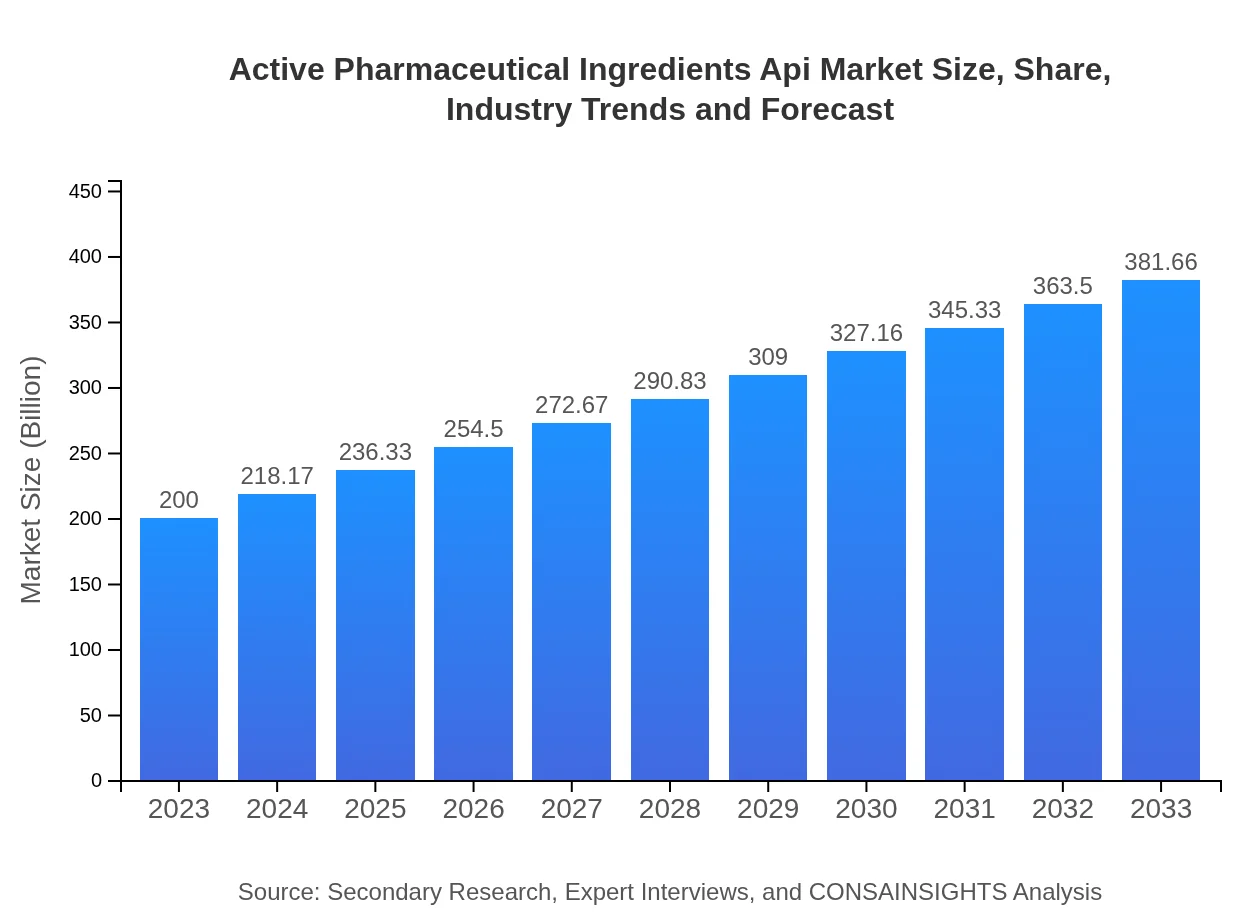
Active Pharmaceutical Ingredients Api Market — USD 200 billion in 2023, Growing to USD 381.66B by 2033 at 6.5% CAGR
This report provides a comprehensive analysis of the Active Pharmaceutical Ingredients (API) market from 2023 to 2033, including insights on market size, trends, segmentation, regional analysis, and forecasts.
Key Takeaways
- Global market value rises from $200.00 Billion in 2023 to $381.66 Billion by 2033 with a 6.5% CAGR.
- North America is largest regional market, while no single fastest-growing region is stated because regional CAGR differences remain within 0.15 percentage points.
- Europe grows from $56.84 Billion in 2023 to $108.47 Billion in 2033, reflecting sustained demand for APIs.
- Asia Pacific expands from $37.7 Billion in 2023 to $71.94 Billion in 2033, driven by pharmaceutical production capacity.
- Top players include Pfizer Inc., BASF SE, Teva Pharmaceutical Industries Ltd., Boehringer Ingelheim, and Mylan N.V.
Active Pharmaceutical Ingredients Api Market Report — Executive Summary
North America remains largest market by forecast-period value, while no single fastest-growing region is stated because top regional growth rates are separated by less than 0.15 percentage points. This report examines the Active Pharmaceutical Ingredients Api market across a 2023 to 2033 forecast, where global value increases from $200.00 Billion to $381.66 Billion at a 6.5% CAGR. Growth is supported by higher pharmaceutical manufacturing, advances in biotechnology, and rising prevalence of chronic diseases. The market structure covers ingredient types, applications, formulations, and manufacturing processes, highlighting chemical synthesis and biotechnology as principal production routes. Regional performance is detailed with North America identified as the largest market. Competitive dynamics include established pharmaceutical firms and generic manufacturers such as Pfizer Inc., BASF SE, Teva Pharmaceutical Industries Ltd., Boehringer Ingelheim, and Mylan N.V. Regulatory requirements, outsourcing trends, and investments in biopharmaceutical R&D are noted as key influences shaping market opportunities and challenges during the forecast period.
Key Growth Drivers
- Rising pharmaceutical production volumes that increase demand for active pharmaceutical ingredients.
- Advancements in biotechnology enabling development and manufacture of complex biologic APIs.
- Growing incidence of chronic diseases creating sustained application demand for API products.
- Regulatory emphasis on quality and compliance prompting investments in manufacturing capabilities.
- Outsourcing trends as firms seek cost efficiencies and expanded product portfolios through third-party API suppliers.
| Metric | Value |
|---|---|
| Study Period | 2023 - 2033 |
| 2023 Market Size | $200.00 Billion |
| CAGR (2023-2033) | 6.5% |
| 2033 Market Size | $381.66 Billion |
| Top Companies | Pfizer Inc., BASF SE, Teva Pharmaceutical Industries Ltd., Boehringer Ingelheim, Mylan N.V. |
| Published Date | 08 October 2024 |
| Last Modified Date | 25 May 2026 |
Active Pharmaceutical Ingredients API Market Overview
Customize Active Pharmaceutical Ingredients Api Market Report market research report
- ✔ Get in-depth analysis of Active Pharmaceutical Ingredients Api market size, growth, and forecasts.
- ✔ Understand Active Pharmaceutical Ingredients Api's regional dynamics and industry-specific trends.
- ✔ Identify potential applications, end-user demand, and growth segments in Active Pharmaceutical Ingredients Api
What is the Market Size & CAGR of Active Pharmaceutical Ingredients Api Market Report market in 2023?
Active Pharmaceutical Ingredients API Industry Analysis
Active Pharmaceutical Ingredients API Market Segmentation and Scope
Tell us your focus area and get a customized research report.
Active Pharmaceutical Ingredients Api Market Report Market Analysis Report by Region
Europe Active Pharmaceutical Ingredients Api Market Report:
Europe grows from $56.84 Billion in 2023 to $108.47 Billion in 2033. This progression reflects established pharmaceutical industries, regulatory frameworks emphasizing quality, and investments in both chemical and biologic API production.Asia Pacific Active Pharmaceutical Ingredients Api Market Report:
Asia Pacific grows from $37.7 Billion in 2023 to $71.94 Billion in 2033. Growth is linked to expanding manufacturing capability, increasing regional pharmaceutical output, and cost-competitive production hubs supporting API supply.North America Active Pharmaceutical Ingredients Api Market Report:
North America is largest regional market, rising from $75.76 Billion in 2023 to $144.57 Billion in 2033. Regional expansion is underpinned by substantial pharmaceutical manufacturing capacity, strong demand for finished drugs, and investments in biopharmaceutical R&D.South America Active Pharmaceutical Ingredients Api Market Report:
Latin America grows from $1.88 Billion in 2023 to $3.59 Billion in 2033. Regional demand is influenced by growing healthcare needs and gradual expansion of local pharmaceutical manufacturing capacities.Middle East & Africa Active Pharmaceutical Ingredients Api Market Report:
Middle East and Africa grows from $27.82 Billion in 2023 to $53.09 Billion in 2033. Growth drivers include rising healthcare investments, improving access to medicines, and regional efforts to strengthen pharmaceutical manufacturing.Tell us your focus area and get a customized research report.
Research Methodology
Active Pharmaceutical Ingredients Api Market Analysis By Ingredient
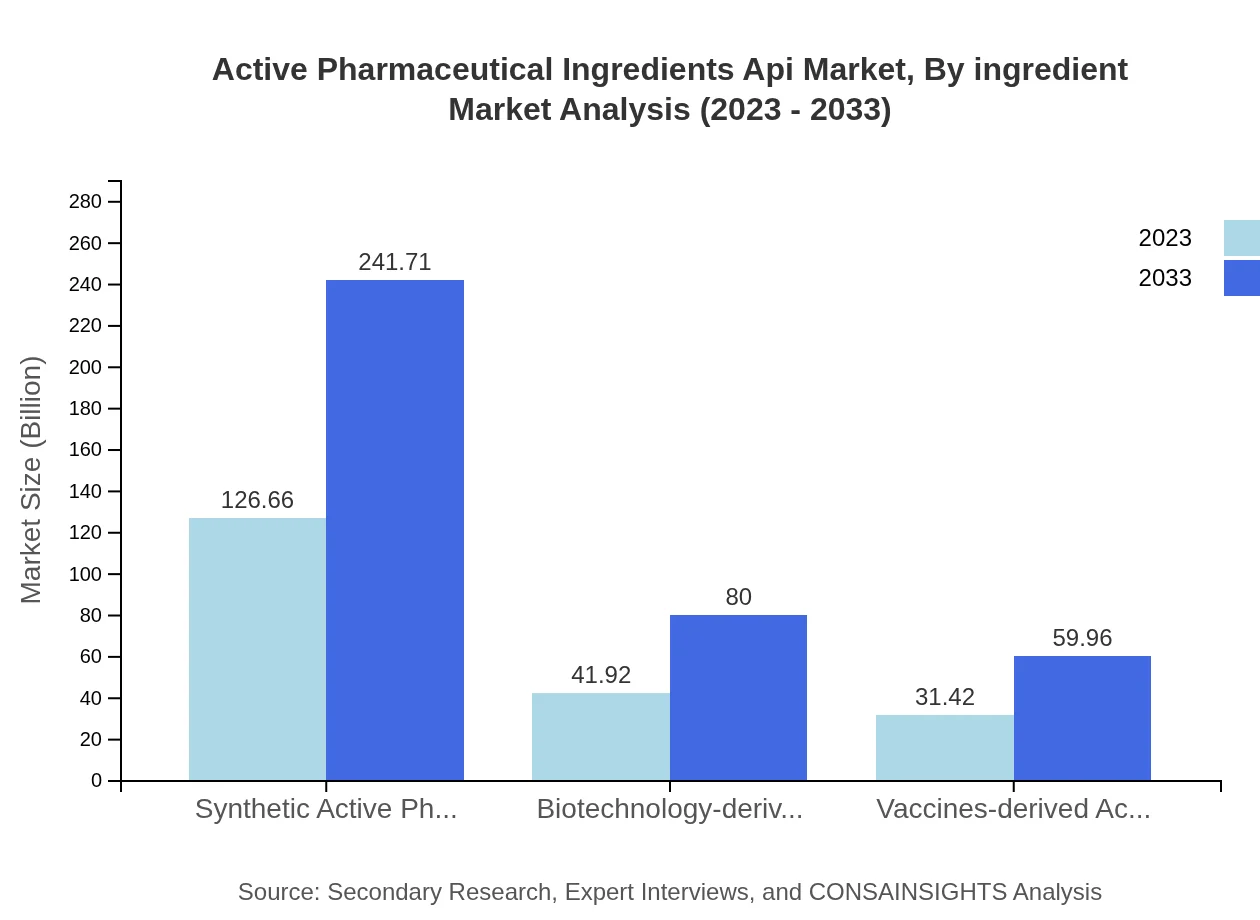
Synthetic Active Pharmaceutical Ingredients dominate the market, projected to grow from $126.66 billion in 2023 to $241.71 billion in 2033, holding a steady market share. Biotechnology-derived APIs will also witness strong growth, with an increase from $41.92 billion to $80 billion within the same timeframe. Vaccines-based APIs remain vital due to their specialized applications, expected to rise from $31.42 to $59.96 billion.
Active Pharmaceutical Ingredients Api Market Analysis By Application
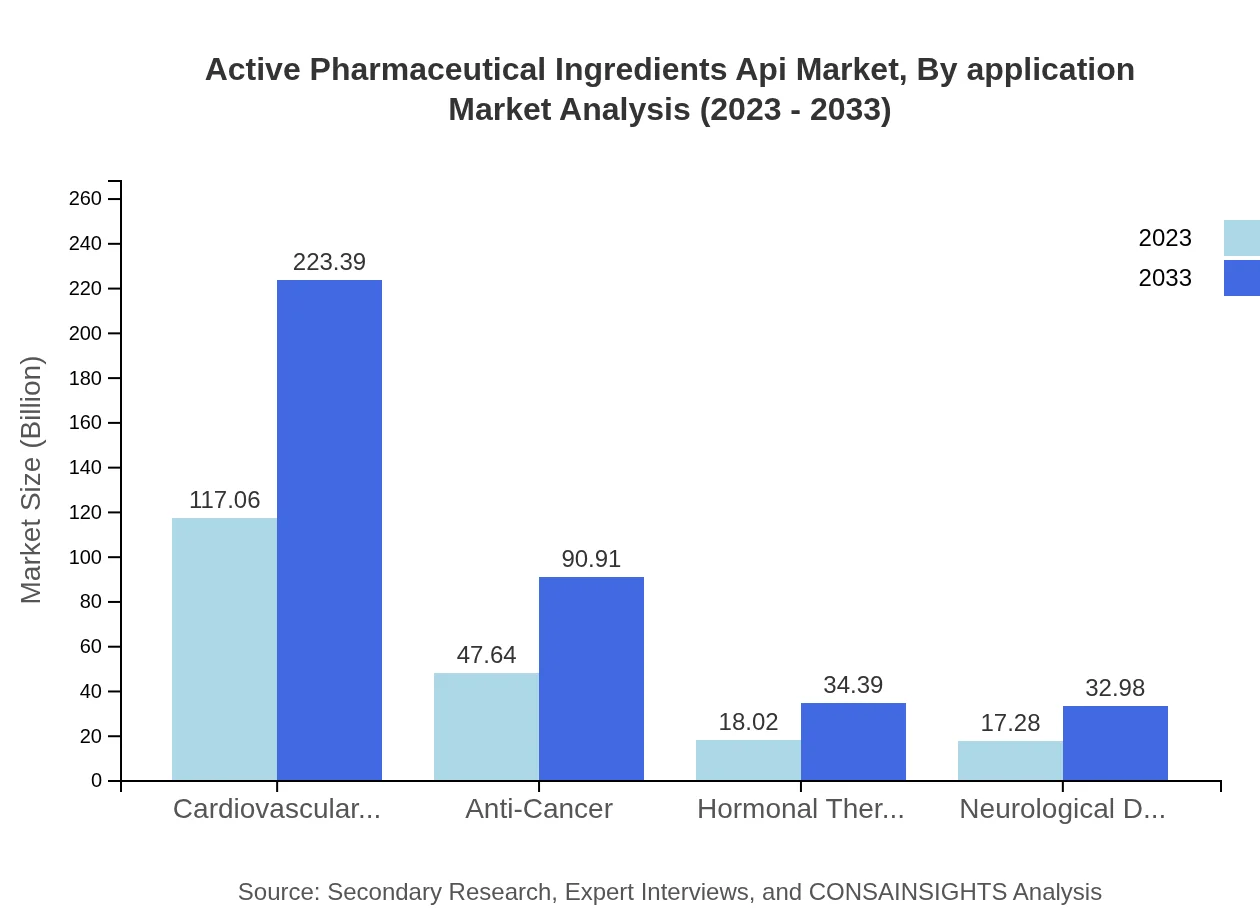
The cardiovascular segment holds the largest market share, transitioning from $117.06 billion in 2023 to $223.39 billion in 2033. Anti-cancer APIs also present substantial growth, from $47.64 billion to $90.91 billion. Hormonal therapies and neurological disorder treatments are expected to maintain their user base, steadily growing due to increasing patient populations.
Active Pharmaceutical Ingredients Api Market Analysis By Manufacturing Process
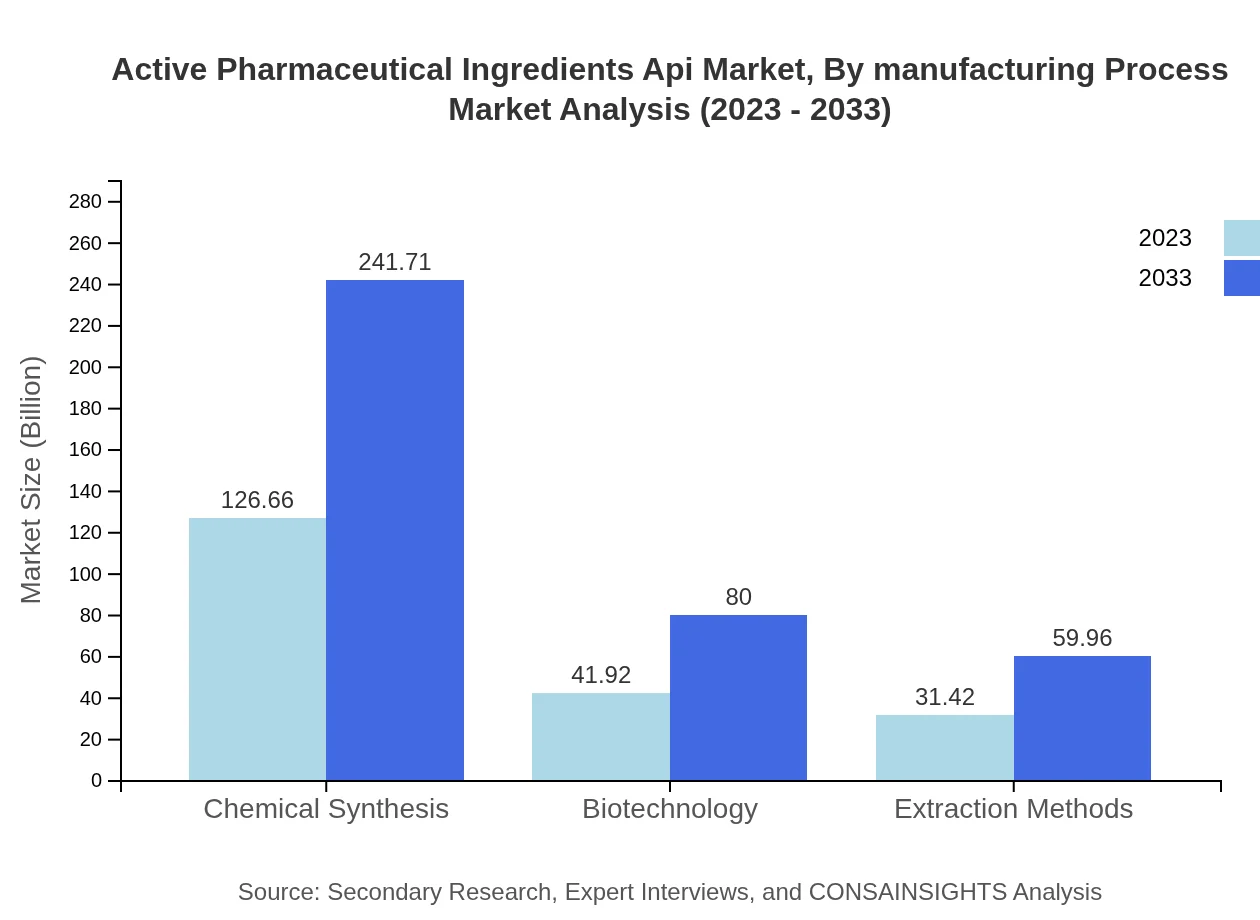
The API market is predominantly driven by Chemical Synthesis, projected to grow from $126.66 billion in 2023 to $241.71 billion by 2033. Biotechnology processes are gaining traction, with significant growth from $41.92 billion to $80 billion. Extraction methods present niche opportunities as biologically diverse therapeutic needs rise.
Active Pharmaceutical Ingredients Api Market Analysis By Formulation
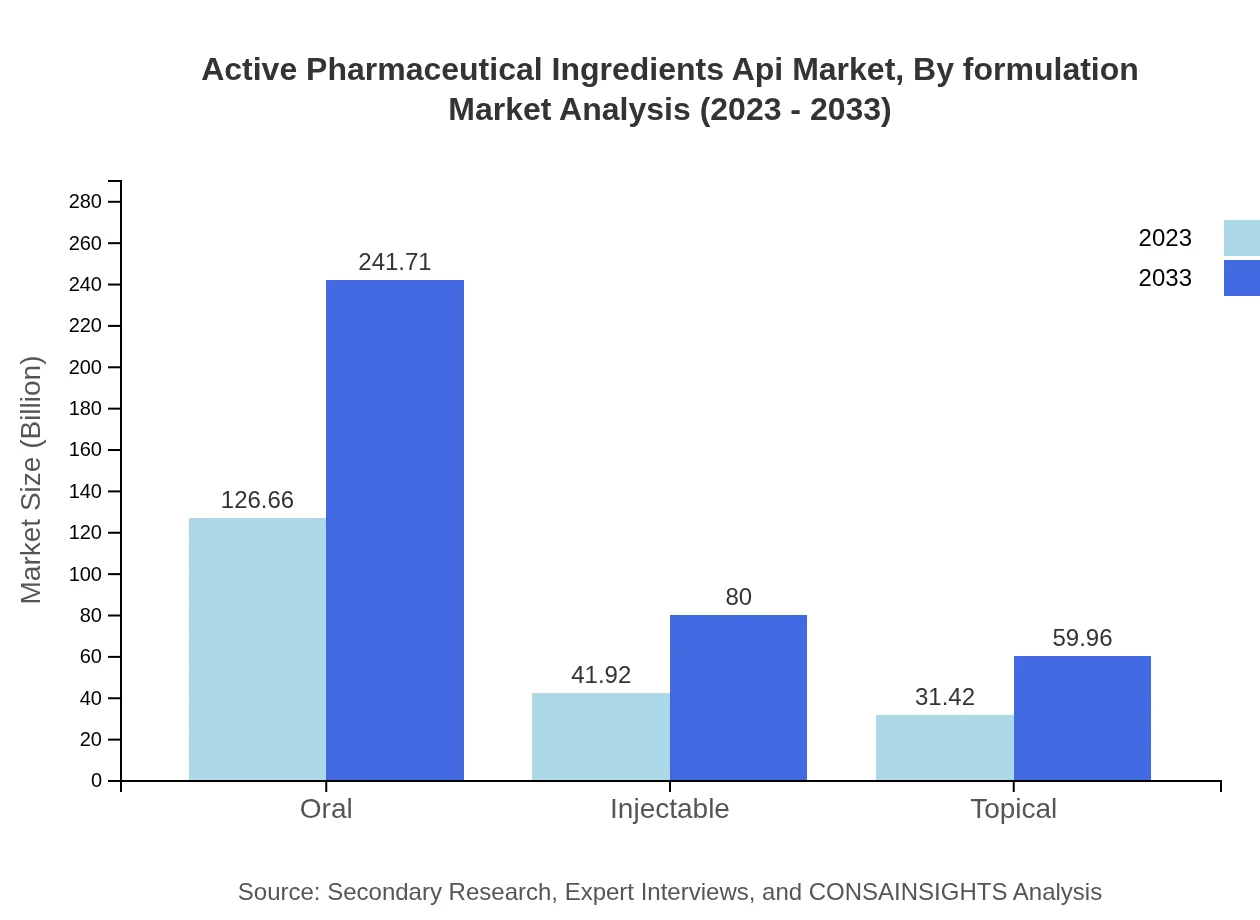
Oral formulations dominate the market with significant size from $126.66 billion to $241.71 billion. Injectable formulations are also on the rise from $41.92 billion to $80 billion as they gain traction for specific therapies. Topical formulations grow steadily from $31.42 billion to $59.96 billion due to lifestyle and skincare trends.
Active Pharmaceutical Ingredients API Market Trends and Future Forecast
Tell us your focus area and get a customized research report.
Global Market Leaders and Top Companies in Active Pharmaceutical Ingredients API Industry
Pfizer Inc.:
A leader in the biopharmaceutical sector, Pfizer produces a wide range of APIs and engages in extensive R&D for new drugs.BASF SE:
As a global chemical company, BASF is pivotal in the API market, producing organic and inorganic substances for pharmaceuticals.Teva Pharmaceutical Industries Ltd.:
A prominent player specializing in generic APIs, Teva contributes to drug accessibility globally, focusing on sustainable production methods.Boehringer Ingelheim:
Engaged in the development of complex APIs, Boehringer Ingelheim leads in biopharmaceutical services and manufacturing.Mylan N.V.:
Mylan specializes in generic medicines and aims to provide high-quality APIs in various therapeutic areas, contributing to a large pool of drugs.We're grateful to work with incredible clients.







FAQs
What is the market size in 2023?
The market size in 2023 is $200.00 Billion as reported for the Active Pharmaceutical Ingredients Api market.
How big will the market be in 2033?
The market is projected to reach $381.66 Billion in 2033 based on the provided forecast for the 2023 to 2033 period.
What is CAGR for the forecast period?
The compounded annual growth rate for the 2023 to 2033 forecast period is 6.5% as stated in the report data.
Is there a single fastest Growing region in the Active Pharmaceutical Ingredients Api Market Report market?
No single fastest-growing region is stated for the Active Pharmaceutical Ingredients Api Market Report market because the top regional implied CAGR values are within 0.15 percentage points of each other, making the ranking too close to call reliably.
Which companies lead the API market?
Top companies listed include Pfizer Inc., BASF SE, Teva Pharmaceutical Industries Ltd., Boehringer Ingelheim, and Mylan N.V.
What key trends influence API demand?
Key trends include greater investment in biotechnology, outsourcing of API production, and increased regulatory focus on manufacturing quality and compliance.
What are common API manufacturing methods?
Primary manufacturing approaches noted are chemical synthesis, biotechnology-driven processes, and extraction methods as core production techniques.
How is the market segmented?
The market is divided by ingredient types, applications, formulations, and manufacturing processes, covering synthetic, biotechnology-derived, and vaccine-derived APIs.
Who provided the research inputs?
Research inputs included primary interviews with industry experts and secondary data from company reports and publications, supplemented by internal validation.
Why are regulatory standards important?
Regulatory standards drive quality requirements, influence manufacturing investments, and affect sourcing decisions across the API value chain.