
Reports >
Life Sciences
>
Ai In Medical Research

Ai In Medical Research
Published Date: 21 April 2026 | Report Code: ai-in-medical-research
Ai In Medical Research Market Size, Share, Industry Trends and Forecast to 2033
This comprehensive report on Ai In Medical Research explores dynamic market trends, technological advancements, and evolving industry landscape between 2024 and 2033. It provides detailed insights on market size, growth rates, regional analysis, segmentation, and forecasts. Readers will be guided through key data points and analytical perspectives to understand the shifting dynamics within this innovative healthcare arena.
Key Takeaways
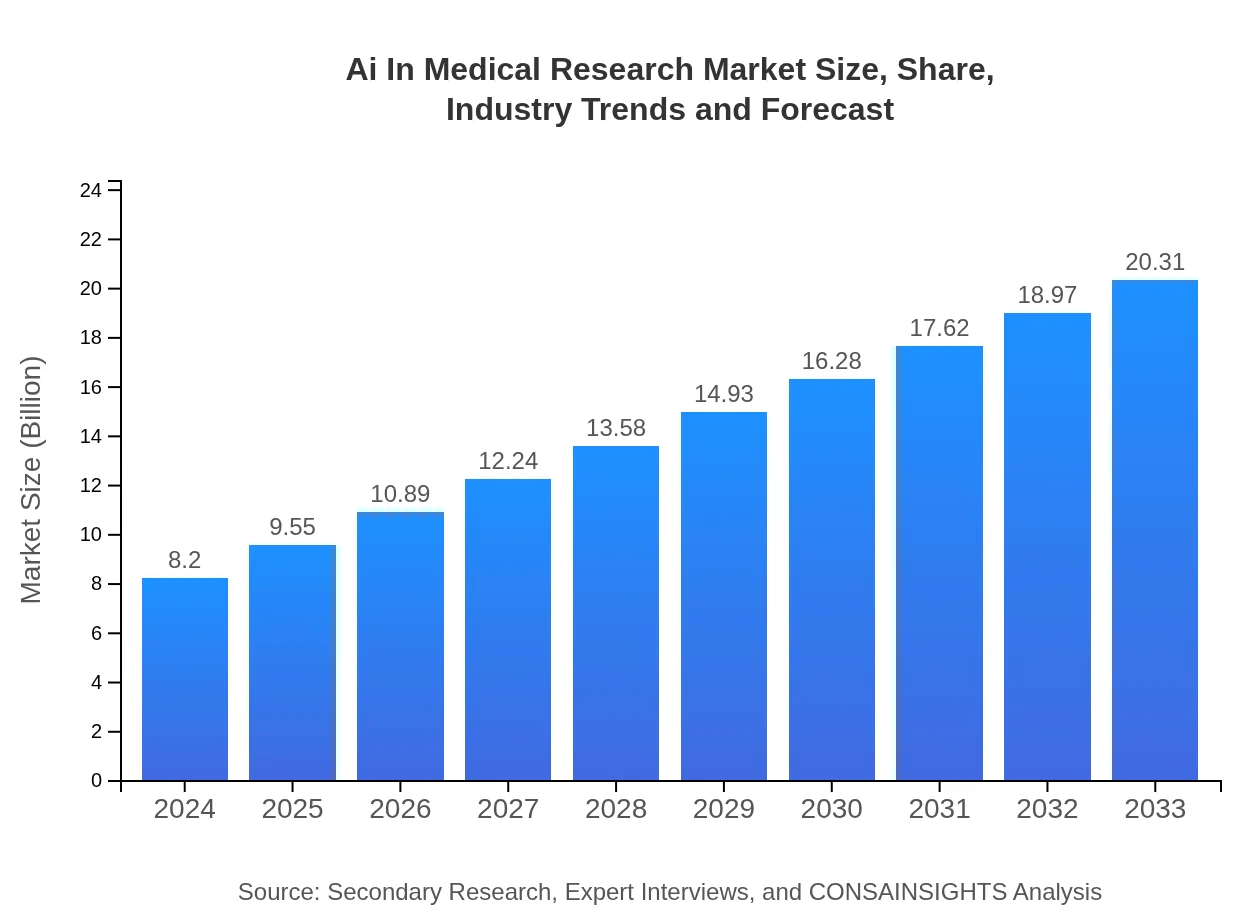
- Market value begins at $8.20 Billion and reaches $20.31 Billion by 2033, implying sustained expansion through 2024–2033.
- Projected CAGR of 10.2% reflects strong adoption across drug discovery, diagnostics, clinical trial workflows, and patient management.
- North America is both the largest and the fastest-growing region, fueled by investment, research institutions, and vendor presence.
- Machine learning, natural language processing, and computer vision drive most solution development and industry uptake.
- Major vendors such as Google Health, IBM Watson Health, Siemens Healthineers, and GE Healthcare are prominent in platform and tool development.
Ai In Medical Research — Executive Summary
The Ai In Medical Research market is positioned for significant expansion, rising from $8.20 Billion to $20.31 Billion by 2033 at a 10.2% CAGR over the 2024 to 2033 forecast period. Growth is propelled by improved algorithms in machine learning, natural language processing, and computer vision that enhance drug discovery, diagnostic accuracy, clinical trial efficiency, and patient management workflows. North America is the largest market and shows the fastest growth, supported by active research institutions, hospital networks, and strong vendor activity from Google Health, IBM Watson Health, Siemens Healthineers, and GE Healthcare. The report analyzes segmentation across region, end-user, technology, application, and functionality—highlighting subsegments such as pharmaceutical companies, biotechnology firms, research institutes, hospitals and clinics; technologies including machine learning, NLP, and computer vision; and applications spanning drug discovery, diagnostics, clinical trial optimization, and patient management. The competitive landscape emphasizes major global suppliers and evolving partnerships between tech providers and life-sciences organizations. This structured approach helps stakeholders identify investment opportunities and adoption pathways during the forecast period.
Key Growth Drivers
- Advances in machine learning, NLP, and computer vision that improve analytical accuracy and accelerate research workflows.
- Rising use of AI in drug discovery and clinical trial optimization, shortening development timelines for pharmaceutical and biotechnology firms.
- Increasing integration of AI-driven diagnostic tools and patient management systems within hospitals and clinics.
- Strong vendor activity and platform development by companies such as Google Health, IBM Watson Health, Siemens Healthineers, and GE Healthcare.
- Greater investment in data analytics by research institutes and life-sciences organizations enabling scalable AI deployment.
| Metric | Value |
|---|---|
| Study Period | 2024 - 2033 |
| 2024 Market Size | $8.20 Billion |
| CAGR (2024-2033) | 10.2% |
| 2033 Market Size | $20.31 Billion |
| Top Companies | Google Health, IBM Watson Health, Siemens Healthineers, GE Healthcare |
| Last Modified Date | 21 April 2026 |
Ai In Medical Research Market Overview
Customize Ai In Medical Research market research report
- ✔ Get in-depth analysis of Ai In Medical Research market size, growth, and forecasts.
- ✔ Understand Ai In Medical Research's regional dynamics and industry-specific trends.
- ✔ Identify potential applications, end-user demand, and growth segments in Ai In Medical Research
What is the Market Size & CAGR of Ai In Medical Research market in 2024?
Ai In Medical Research Industry Analysis
Ai In Medical Research Market Segmentation and Scope
Tell us your focus area and get a customized research report.
Ai In Medical Research Market Analysis Report by Region
Europe Ai In Medical Research:
Europe begins at $2.6 Billion in 2024 and expands to $6.43 Billion in 2033. Regional growth is driven by collaborative research networks, rising adoption of analytics in diagnostics and trials, and activity among medical technology providers.Asia Pacific Ai In Medical Research:
Asia Pacific moves from $1.56 Billion in 2024 to $3.86 Billion in 2033. Growth reflects increasing technology adoption across research institutes and hospitals, rising life-sciences investment, and expanding use of AI for drug discovery and diagnostics.North America Ai In Medical Research:
North America starts from $2.85 Billion in 2024 and grows to $7.06 Billion in 2033. The region’s scale and speed reflect concentrated research institutions, strong hospital systems, active vendor presence, and sizeable investment in AI-enabled medical research solutions.South America Ai In Medical Research:
Middle East & Africa Ai In Medical Research:
Middle East and Africa grows from $0.77 Billion in 2024 to $1.91 Billion in 2033. Regional drivers include rising investment in healthcare infrastructure, growing research collaborations, and adoption of AI for clinical and diagnostic applications.Tell us your focus area and get a customized research report.
Research Methodology
Ai In Medical Research Market Analysis By Technology
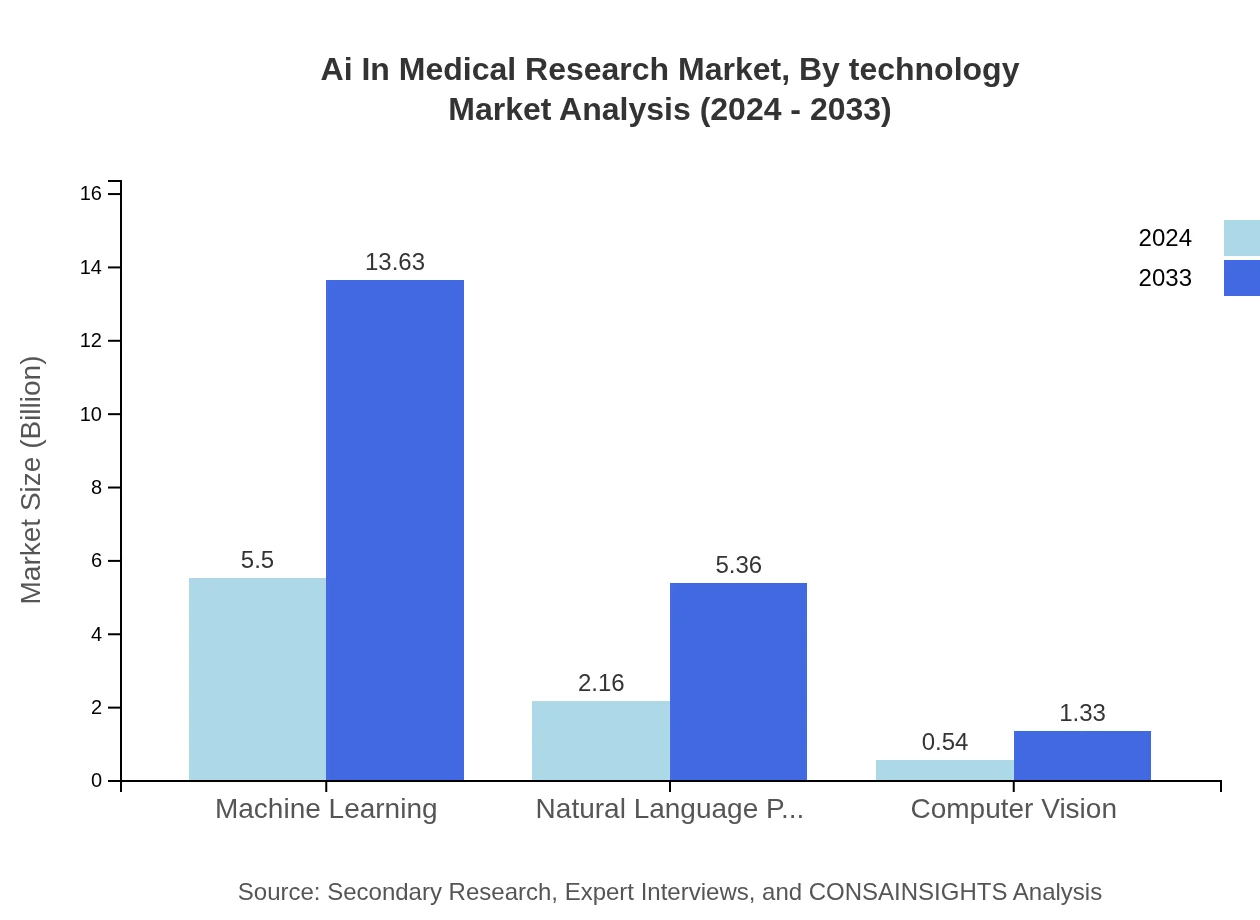
The technology segment in AI in Medical Research is primarily driven by the integration of machine learning, natural language processing, and computer vision. In 2024, machine learning held a significant market share with a size of 5.50, expanding to 13.63 by 2033, accounting for approximately 67.08% market share over the period. Natural language processing and computer vision, while smaller in scale, are integral to qualitative breakthroughs in diagnostic accuracy and patient data interpretation. Continuous improvements in algorithm performance and computational power are paving the way for enhanced predictive capabilities, thereby catalyzing further investments in these domains. Overall, technological innovations are driving operational efficiencies and accelerating research outputs, making this segment pivotal for overall market growth.
Ai In Medical Research Market Analysis By Application
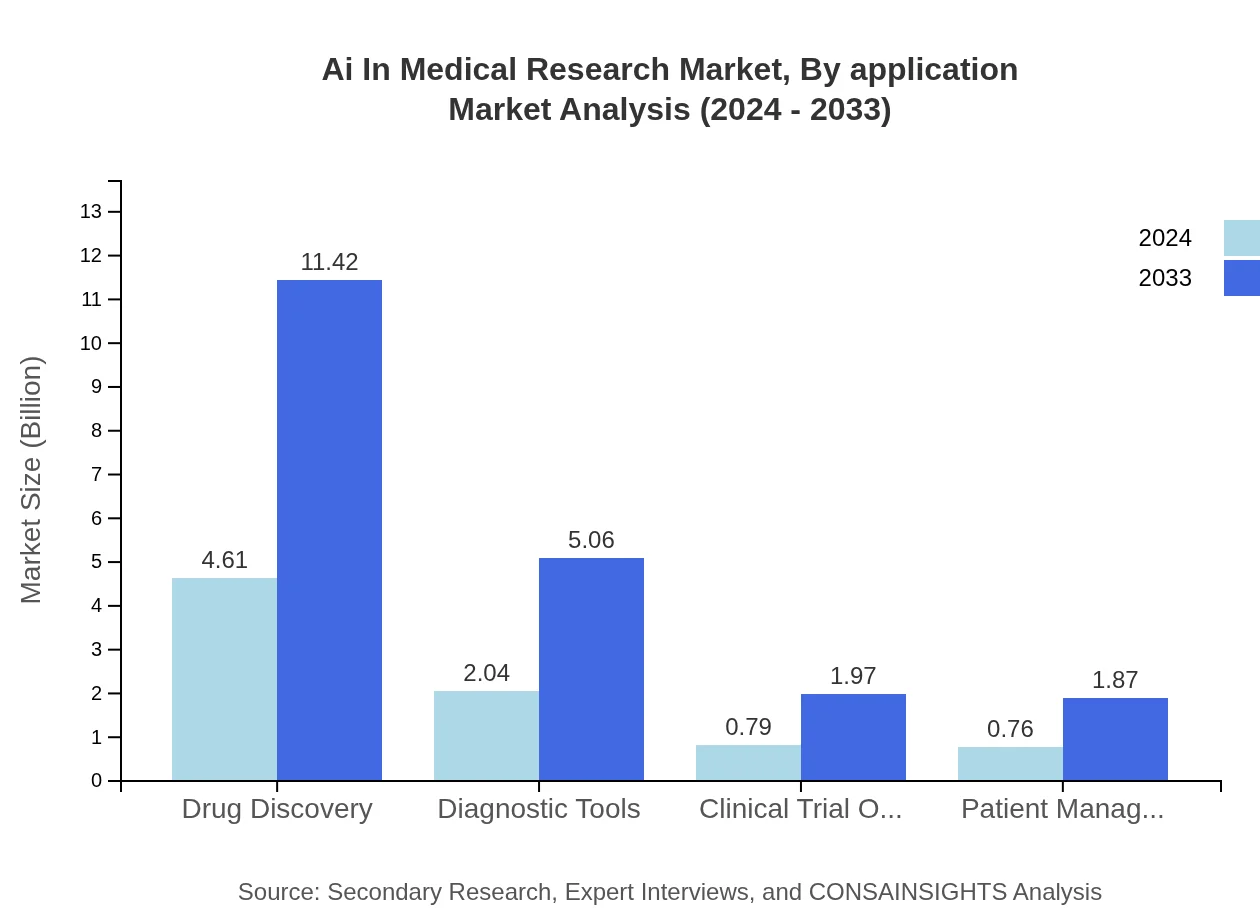
Application-wise, AI in Medical Research is segmented into areas such as drug discovery, diagnostic tools, clinical trial optimization, and patient management. Among these, drug discovery showcases prominent growth with market sizes increasing from 4.61 in 2024 to 11.42 in 2033 and maintaining a robust share of 56.2%. Diagnostic tools and clinical trial optimization further support the market by enhancing image interpretation and operational efficiencies in clinical settings. Patient management solutions, although displaying smaller figures, contribute significantly by delivering personalized care and predictive insights. Advances in application-specific algorithms and integration of multi-modal data sources are creating new opportunities, thus solidifying the importance of these applications in revolutionizing medical research methodologies.
Ai In Medical Research Market Analysis By End User
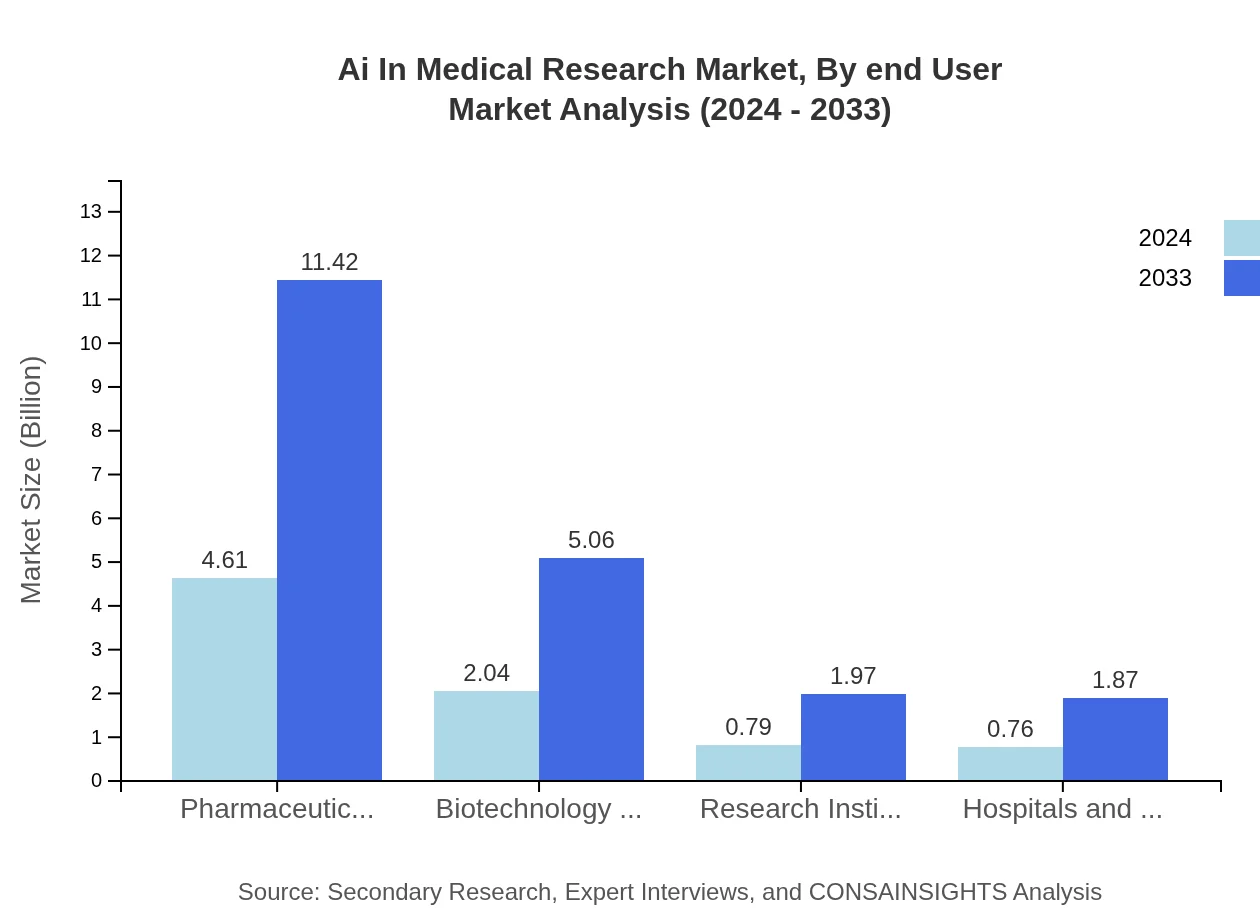
The end-user segment encompasses pharmaceutical companies, biotechnology firms, research institutes, and hospitals and clinics. Pharmaceutical companies are at the forefront, holding a market size of 4.61 in 2024 and expected to reach 11.42 by 2033, with a commanding share of 56.2%, driven by their need for rapid drug development and risk mitigation in clinical trials. Biotechnology firms, research institutes, and hospitals complement this growth by adopting AI to enhance operational efficiencies and improve patient outcomes. The diverse end-user base fosters a collaborative ecosystem where technological adoption is accelerated, leading to innovations that are instrumental in reducing research timelines and optimizing healthcare delivery processes.
Ai In Medical Research Market Analysis By Functionality
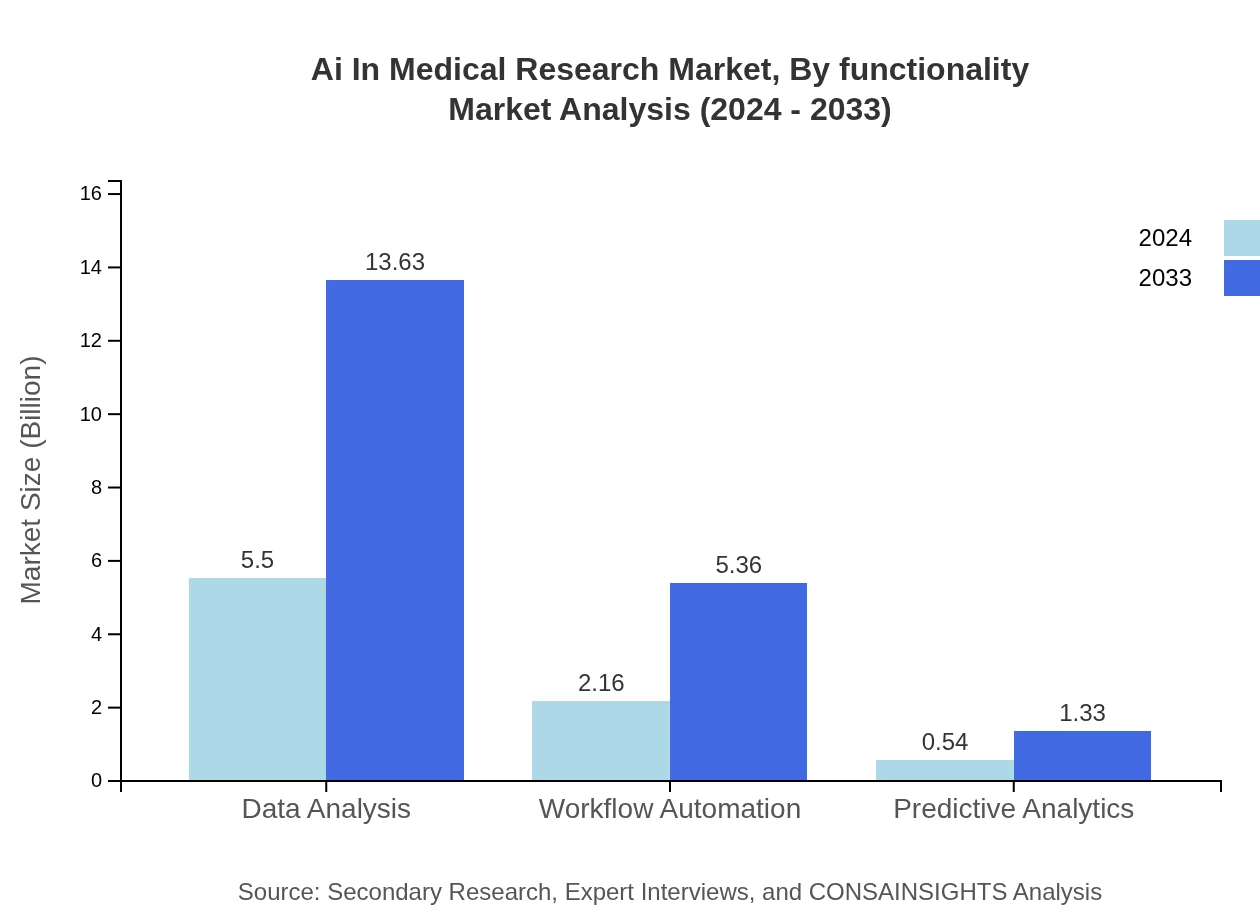
The functionality segment is built around the core aspects of data analysis, workflow automation, and predictive analytics. Data analysis dominates this segment with figures growing from 5.50 in 2024 to 13.63 in 2033, representing approximately 67.08% market share as organizations increasingly rely on AI for mining complex datasets to extract actionable insights. Workflow automation and predictive analytics, with growth patterns of 2.16 to 5.36 and 0.54 to 1.33 respectively, are critical in streamlining research processes and anticipating future trends. These functionalities not only boost efficiency but also enhance reproducibility and accuracy, making them indispensable to modern medical research operations.
Ai In Medical Research Market Analysis By Region
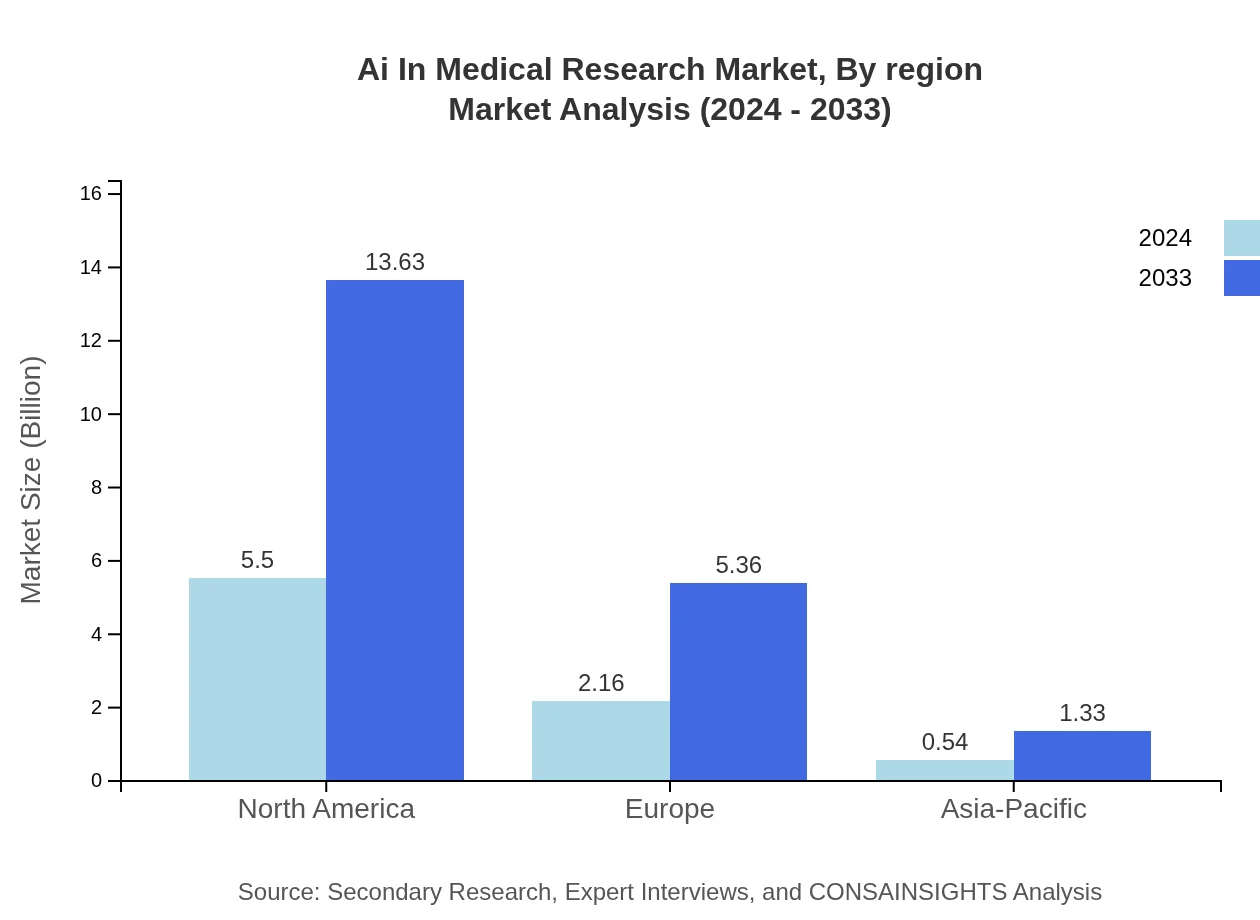
The regional segmentation of the AI in Medical Research market provides insights into geographical trends which vary significantly across the globe. North America leads with advanced technological infrastructure and regulatory maturity, while Europe benefits from strong investments and progressive healthcare policies. The Asia Pacific region presents tremendous growth potential, fueled by rapid digital health adoption and emerging local innovations. Meanwhile, regions like South America and the Middle East and Africa, although currently smaller in scale, are witnessing steady improvements as investments and technology transfer increase. This segmentation allows stakeholders to tailor strategies to regional dynamics, thereby optimizing resource allocation and market penetration.
Ai In Medical Research Market Trends and Future Forecast
Tell us your focus area and get a customized research report.
Global Market Leaders and Top Companies in Ai In Medical Research Industry
Google Health:
Google Health leverages advanced AI capabilities to develop innovative healthcare solutions. With a focus on machine learning and data analytics, the company is driving improvements in diagnostic accuracy and personalized treatment plans across various research applications.IBM Watson Health:
IBM Watson Health integrates cognitive computing and artificial intelligence to aid clinical decision-making and streamline research processes. Its robust analytics tools help in accelerating drug discovery and optimizing clinical operations worldwide.Siemens Healthineers:
Siemens Healthineers is at the forefront of digital health with advanced imaging technologies and AI-driven diagnostic tools. Their comprehensive portfolio supports improved patient outcomes and enhanced operational efficiencies in research and clinical settings.GE Healthcare:
GE Healthcare combines innovative AI solutions with extensive medical expertise to transform traditional healthcare delivery. Their solutions focus on predictive analytics and workflow automation, driving efficiency and accuracy across medical research and patient management domains.We're grateful to work with incredible clients.








FAQs
What is the market size in 2023?
The market size was $8.20 Billion in 2023, representing the baseline figure provided for the Ai In Medical Research market before the 2024 to 2033 forecast period.
How big will the market be in 2033?
By 2033 the market is projected to reach $20.31 Billion, reflecting growth over the 2024 to 2033 forecast period at the specified CAGR of 10.2%.
Why is North America the largest region?
North America leads due to concentrated research activity, strong hospital and pharmaceutical networks, significant vendor presence, and higher investment in advanced analytics and AI-driven medical research solutions.
Which region is the fastest Growing?
North America is identified as the fastest-growing region, supported by accelerated adoption of AI technologies across research institutions, healthcare systems, and commercial providers.
Who are the leading companies in this market?
Top companies listed include Google Health, IBM Watson Health, Siemens Healthineers, and GE Healthcare, which are active in developing AI platforms and solutions for medical research applications.
What is CAGR for the forecast period?
The compound annual growth rate (CAGR) for the forecast period 2024 to 2033 is 10.2%, which underpins the projected expansion from the baseline market value to 2033.
What are the primary applications covered?
Primary applications include Drug Discovery, Diagnostic Tools, Clinical Trial Optimization, and Patient Management, reflecting where AI techniques are most commonly applied in medical research workflows.
Which technologies are included in segmentation?
Technologies covered are Machine Learning, Natural Language Processing, and Computer Vision, which form the core technical approaches supporting analytics and automation in medical research.
What end Users are analyzed in the report?
End-user segments include Pharmaceutical Companies, Biotechnology Firms, Research Institutes, and Hospitals and Clinics, representing the principal adopters of AI in medical research.
What research methodology was used?
The methodology comprises primary interviews with industry experts, secondary research via company reports and publications, data triangulation and internal validation, and expert-led trend analysis.