

Ambulatory Healthcare Service Market Report
First published: 21 October 2024 | Last updated: 25 May 2026 | Report Code: ambulatory-healthcare-service
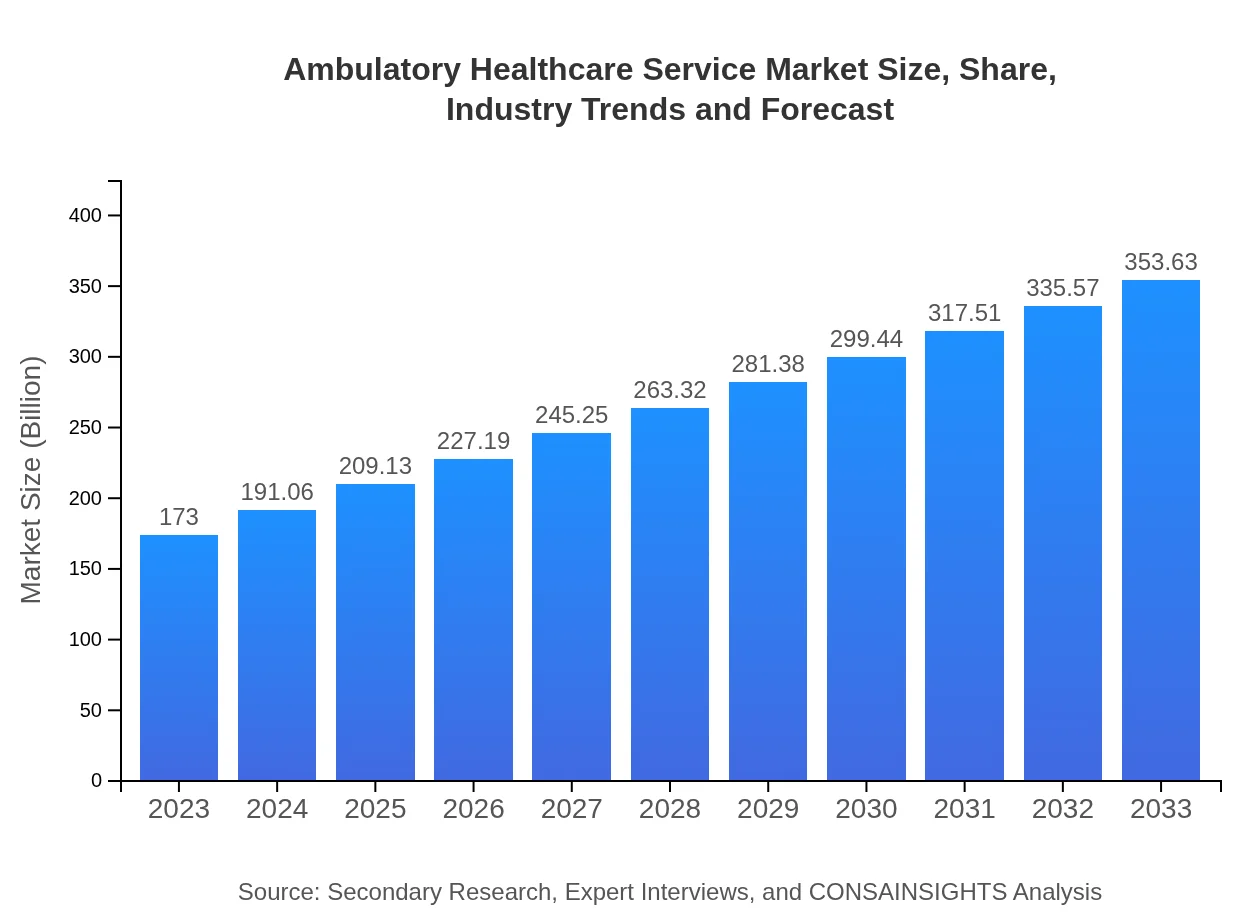
Ambulatory Healthcare Service Market — USD $173 Billion in 2023, Growing to USD 353.63B by 2033 at 7.2% CAGR
This report provides an in-depth analysis of the Ambulatory Healthcare Service market, covering market dynamics, size, trends, regional insights, and forecasts from 2023 to 2033.
Key Takeaways
- $173.00 Billion market value in 2023 expanding to $353.63 Billion by 2033 at a 7.2% CAGR.
- North America is largest regional market, while no single fastest-growing region is stated because regional CAGR differences remain within 0.15 percentage points.
- Europe moves from $53.01 Billion to $108.35 Billion, while Asia Pacific grows from $36.55 Billion to $74.72 Billion.
- Top industry participants include UnitedHealth Group, Tenet Healthcare, HCA Healthcare, Cigna, and Walgreens Boots Alliance.
- Technology adoption—telehealth, wearables, and health IT—underpins service delivery shifts toward outpatient models.
Ambulatory Healthcare Service Market Report — Executive Summary
North America remains largest market by forecast-period value, while no single fastest-growing region is stated because top regional growth rates are separated by less than 0.15 percentage points. The report outlines the ambulatory healthcare sector’s shift toward outpatient-centered care, with total market size expanding from $173.00 Billion in 2023 to $353.63 Billion by 2033 at a 7.2% CAGR for 2023 to 2033. Growth is propelled by digital solutions such as telehealth and health information technology, rising chronic disease prevalence, and preferences for cost-efficient care outside inpatient settings. Regional dynamics vary: North America remains the largest market, supported by established provider networks and investment in outpatient infrastructure. Europe and Asia Pacific also show substantial increases in absolute value. Service and technology segmentation highlights roles for hospitals, clinics, home healthcare providers, telehealth services, wearable devices, and health IT platforms. Revenue models include fee-for-service, capitation, and combined payment approaches. Competitive positioning involves integrated payers and large provider networks, including UnitedHealth Group, Tenet Healthcare, HCA Healthcare, Cigna, and Walgreens Boots Alliance. The analysis synthesizes primary interviews, company documentation, and internal validation to present a structured outlook and actionable insights for stakeholders assessing ambulatory care expansion opportunities.
Key Growth Drivers
- Expansion of telehealth and remote monitoring enabling more services to be delivered outside hospitals.
- Rising incidence of chronic conditions increasing demand for recurring outpatient care and long-term management.
- Shift in payer and provider focus toward cost-effective ambulatory settings and alternative reimbursement models.
- Investment in health information technology improving care coordination and operational efficiency for outpatient providers.
- Patient preference for convenient, same-day services and reduced inpatient stays driving service redesign.
| Metric | Value |
|---|---|
| Study Period | 2023 - 2033 |
| 2023 Market Size | $173.00 Billion |
| CAGR (2023-2033) | 7.2% |
| 2033 Market Size | $353.63 Billion |
| Top Companies | UnitedHealth Group, Tenet Healthcare, HCA Healthcare, Cigna, Walgreens Boots Alliance |
| Published Date | 21 October 2024 |
| Last Modified Date | 25 May 2026 |
Ambulatory Healthcare Service Market Overview
Customize Ambulatory Healthcare Service Market Report market research report
- ✔ Get in-depth analysis of Ambulatory Healthcare Service market size, growth, and forecasts.
- ✔ Understand Ambulatory Healthcare Service's regional dynamics and industry-specific trends.
- ✔ Identify potential applications, end-user demand, and growth segments in Ambulatory Healthcare Service
What is the Market Size & CAGR of Ambulatory Healthcare Service Market Report market in 2023?
Ambulatory Healthcare Service Industry Analysis
Ambulatory Healthcare Service Market Segmentation and Scope
Tell us your focus area and get a customized research report.
Ambulatory Healthcare Service Market Report Market Analysis Report by Region
Europe Ambulatory Healthcare Service Market Report:
Europe grows from $53.01 Billion in 2023 to $108.35 Billion in 2033. 01 Billion in 2023 to $108.35 Billion by 2033. This regional shift reflects rising outpatient service capacity, regulatory emphasis on community-based care, and integration of digital health solutions into routine practice.Asia Pacific Ambulatory Healthcare Service Market Report:
Asia Pacific grows from $36.55 Billion in 2023 to $74.72 Billion in 2033. Growth drivers include rising healthcare demand, adoption of telemedicine, and expansion of outpatient infrastructure to serve growing patient volumes.North America Ambulatory Healthcare Service Market Report:
North America is largest regional market, rising from $55.97 Billion in 2023 to $114.4 Billion in 2033. Regional expansion is tied to established outpatient networks, investment in ambulatory facilities, and broad adoption of telehealth and health IT among providers.South America Ambulatory Healthcare Service Market Report:
Latin America grows from $12.85 Billion in 2023 to $26.27 Billion in 2033. The region’s increase is associated with gradual outpatient service development, expanding access to ambulatory care, and growing use of remote consultation technologies.Middle East & Africa Ambulatory Healthcare Service Market Report:
Middle East and Africa grows from $14.62 Billion in 2023 to $29.88 Billion in 2033. 62 Billion in 2023 to $29.88 Billion by 2033. Investment in ambulatory facilities, technology adoption, and efforts to improve access to non-inpatient care are noted as supporting factors.Tell us your focus area and get a customized research report.
Research Methodology
Ambulatory Healthcare Service Market Analysis By Service Type
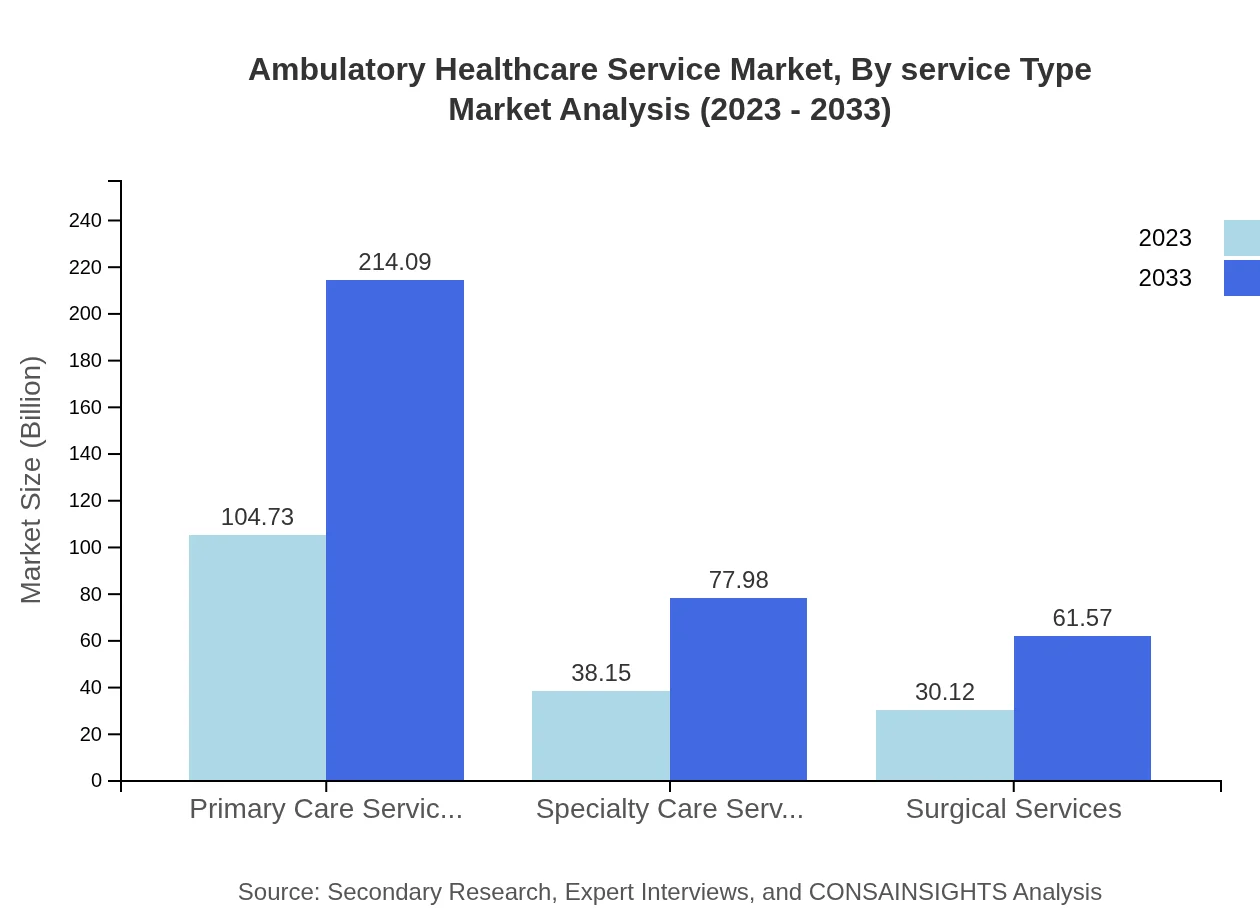
The Ambulatory Healthcare Service market can be segmented by service types such as outpatient surgical services and primary care services. Outpatient surgical services are dominant, with a market size of $104.73 billion in 2023, expected to reach $214.09 billion by 2033. Primary care services are projected to follow closely, reflecting the growing trend toward preventative care and chronic disease management.
Ambulatory Healthcare Service Market Analysis By Patient Type
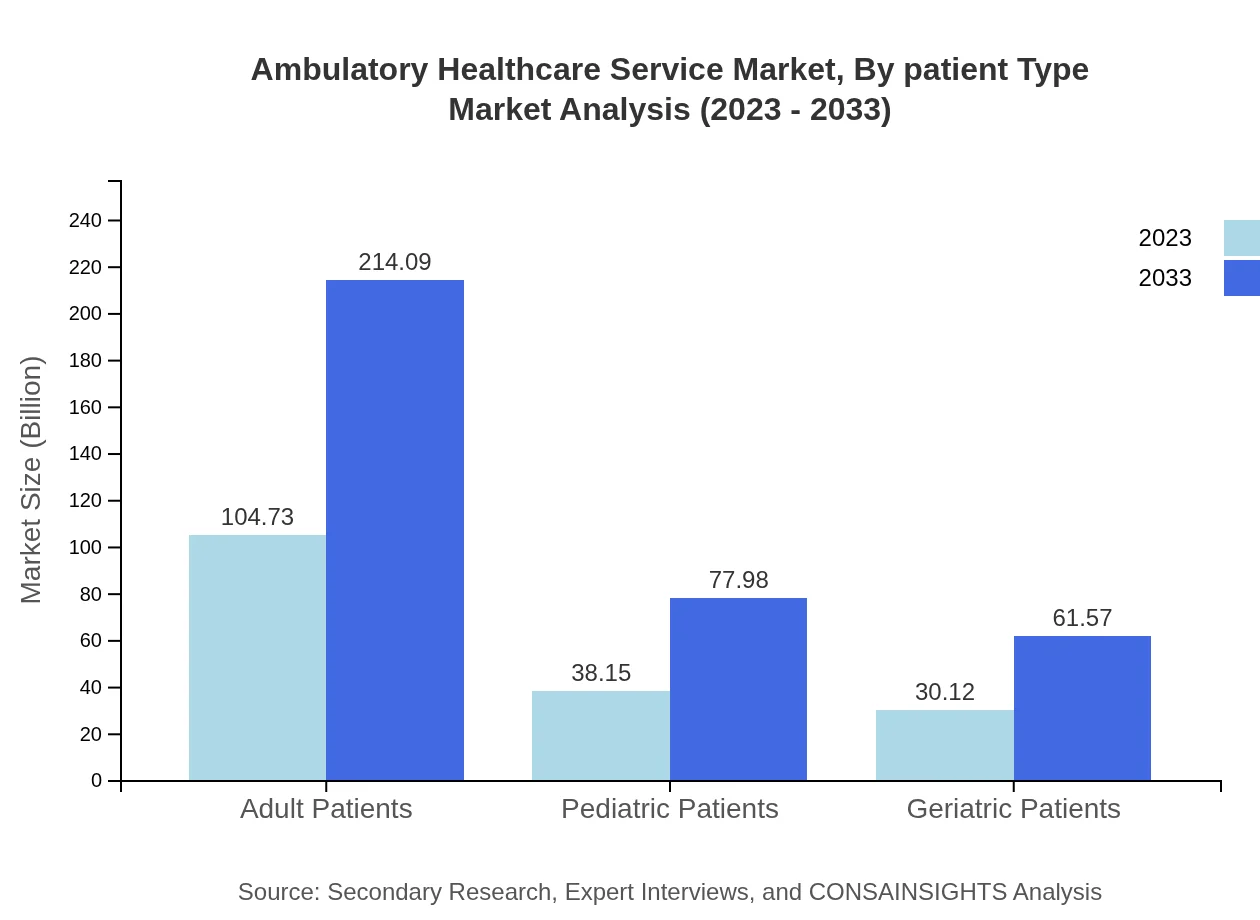
By patient type, adult patients lead the market, holding a significant share with a market size of $104.73 billion in 2023 and projected growth to $214.09 billion by 2033. Pediatric and geriatric patients are also crucial, accounting for market sizes of $38.15 billion and $30.12 billion in 2023, respectively, indicating a growing focus on tailored care for these demographics.
Ambulatory Healthcare Service Market Analysis By End User
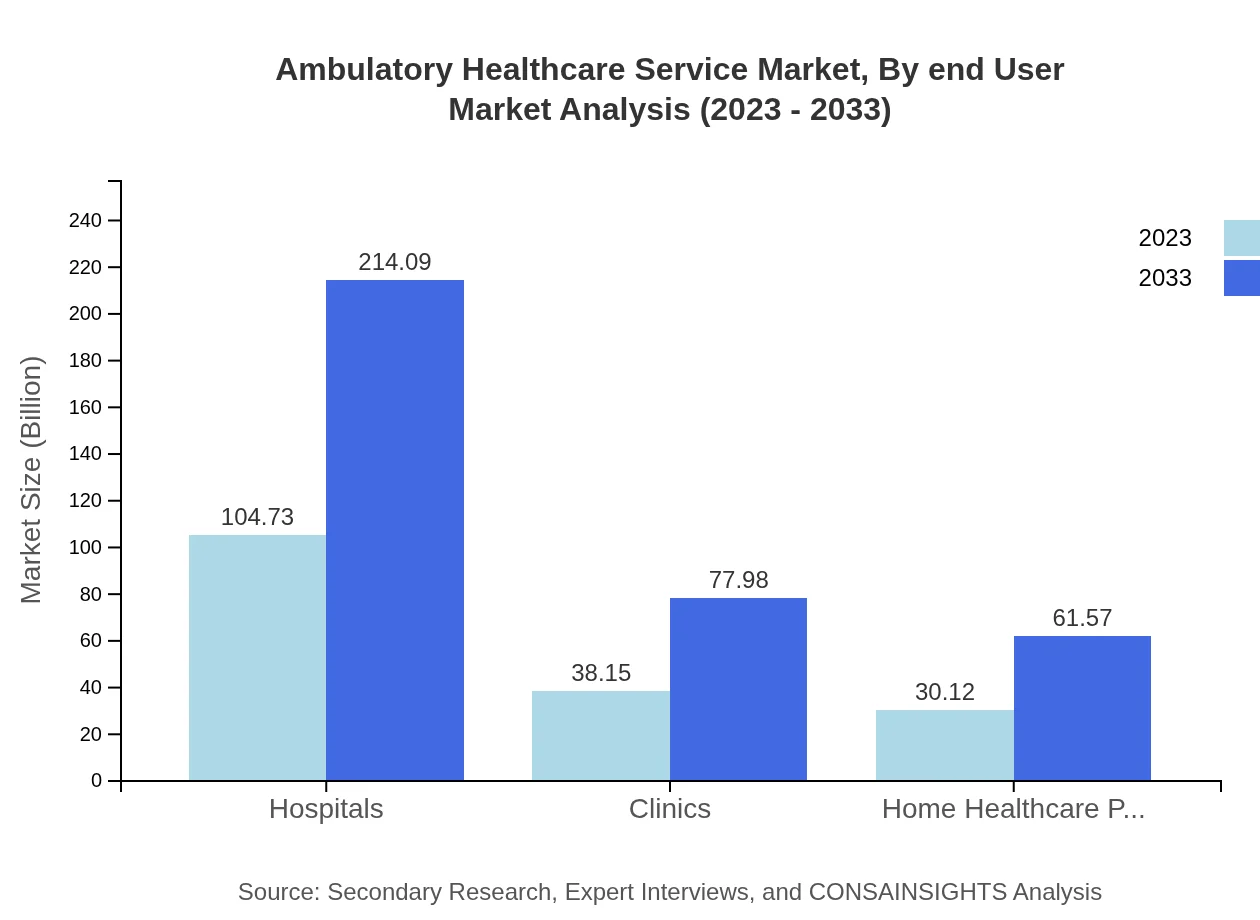
The analysis of end-users highlights hospitals and clinics as primary consumers of ambulatory healthcare services. Hospitals currently account for a substantial market size of $104.73 billion in 2023, maintaining a steady share as they integrate more outpatient services. Clinics, while smaller at $38.15 billion, are expected to show rapid growth as they adapt to increased demand for community-based care.
Ambulatory Healthcare Service Market Analysis By Technology
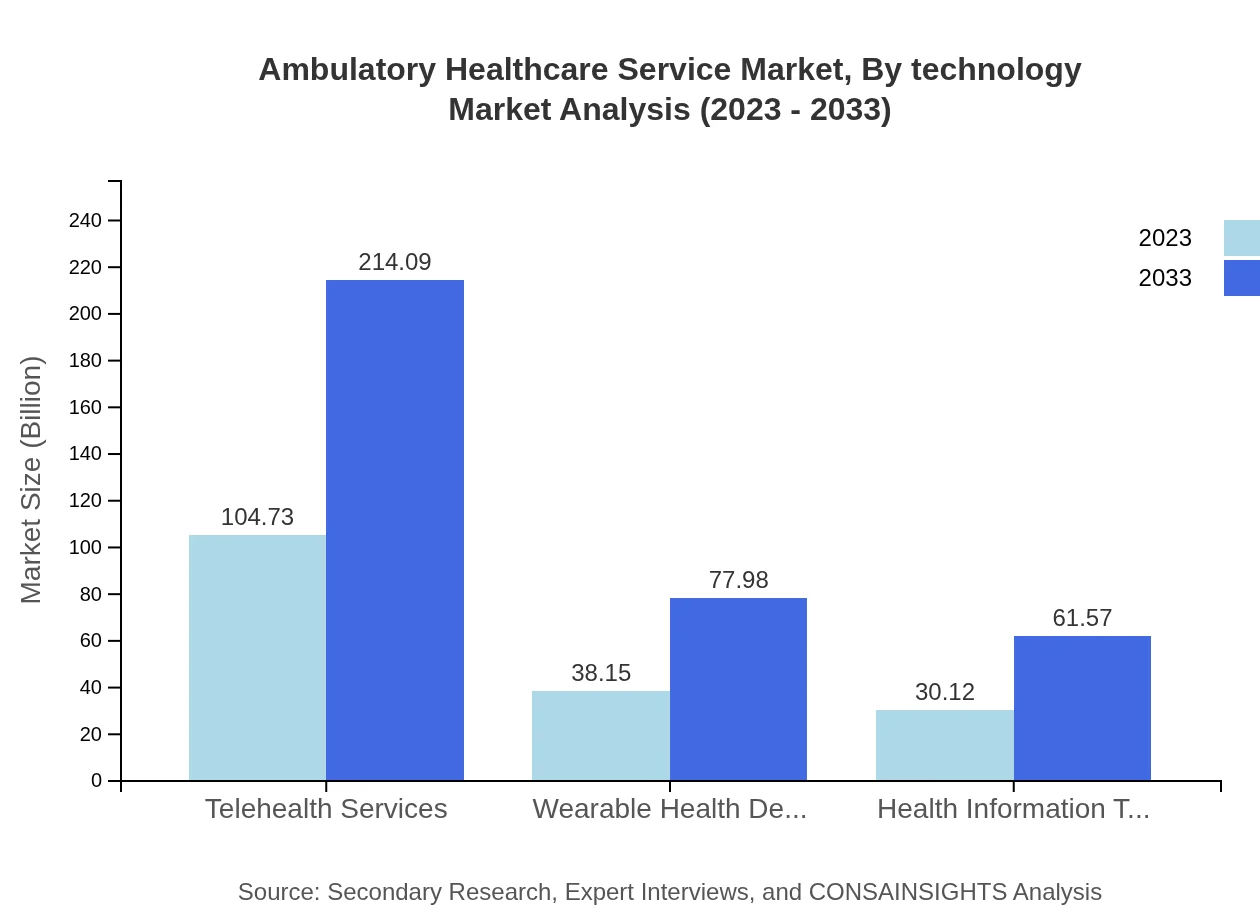
Technological advancement plays a crucial role in the growth of the Ambulatory Healthcare Service market. Key technologies driving growth include telehealth platforms, wearable health devices, and health information technology solutions. The market for health information technology alone is expected to grow from $30.12 billion in 2023 to $61.57 billion by 2033, as healthcare providers leverage technology to enhance patient engagement and care delivery.
Ambulatory Healthcare Service Market Analysis By Revenue Model
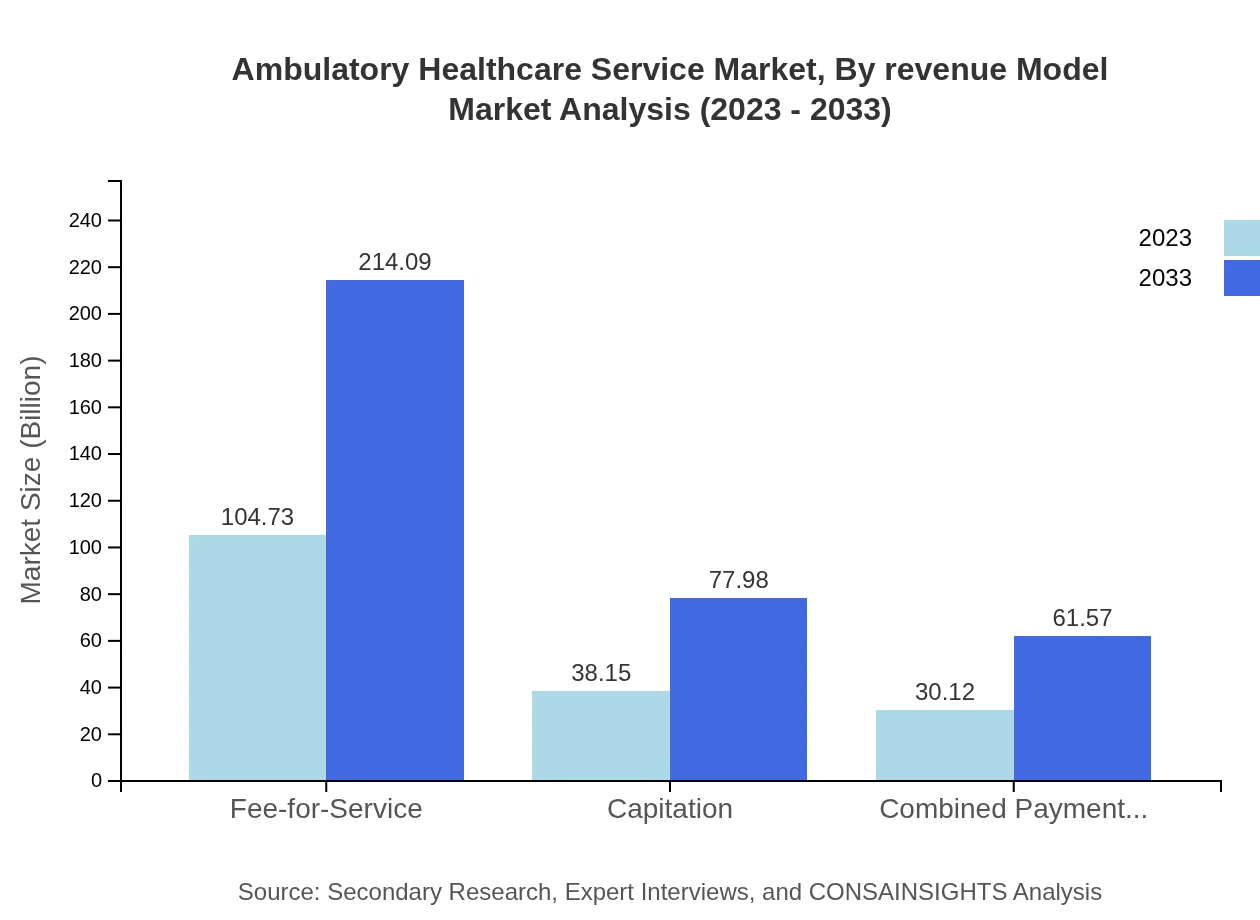
The revenue model segment demonstrates a shift towards alternative payment models, such as capitation and combined payment models. Fee-for-service remains dominant; however, innovative models are gaining traction, reflecting the healthcare sector's transition towards value-based care. Capitation is projected to grow from $38.15 billion in 2023 to $77.98 billion by 2033, showcasing the industry's evolving payment landscape.
Ambulatory Healthcare Service Market Trends and Future Forecast
Tell us your focus area and get a customized research report.
Global Market Leaders and Top Companies in Ambulatory Healthcare Service Industry
UnitedHealth Group:
UnitedHealth Group is a leading diversified health and well-being company in the U.S., actively involved in providing innovative healthcare solutions and managing a broad array of health services and technology.Tenet Healthcare:
Tenet Healthcare is one of the largest healthcare services companies in the United States, offering a range of services including hospital operations and ambulatory care, excelling in patient-centric care.HCA Healthcare:
HCA Healthcare operates numerous healthcare facilities and outpatient services across the U.S. It is known for its focus on high-quality care and innovation within the ambulatory setting.Cigna:
Cigna is a global health service company that provides medical insurance and healthcare services, focusing on integrated care solutions that enhance patient experiences across the ambulatory care spectrum.Walgreens Boots Alliance:
Walgreens Boots Alliance offers various health and wellness services in its pharmacies, including primary and specialized healthcare, enhancing accessibility to ambulatory healthcare for the community.We're grateful to work with incredible clients.









FAQs
What is the market size of the ambulatory healthcare service market in 2023?
The market size in 2023 is $173.00 Billion according to the report’s reported base-year value.
How big will the ambulatory healthcare service market be in 2033?
By 2033 the market is projected to reach $353.63 Billion as stated in the forecast figures provided.
What is CAGR for the forecast period?
The reported compound annual growth rate (CAGR) for 2023 to 2033 is 7.2%.
Is there a single fastest Growing region in the Ambulatory Healthcare Service Market Report market?
No single fastest-growing region is stated for the Ambulatory Healthcare Service Market Report market because the top regional implied CAGR values are within 0.15 percentage points of each other, making the ranking too close to call reliably.
Which companies are featured as leading players?
Top listed firms include UnitedHealth Group, Tenet Healthcare, HCA Healthcare, Cigna, and Walgreens Boots Alliance.
What are common revenue models in ambulatory services?
Revenue approaches reported include fee-for-service, capitation, and combined payment models as outlined in segmentation.
How does technology influence growth?
Adoption of telehealth, wearable devices, and health information technology is cited as a key enabler of outpatient service expansion.
What end User categories are included in the segmentation?
Reported end-users include hospitals, clinics, and home healthcare providers across the by-end-user segmentation.
What service types are covered in the analysis?
Service-type segments listed are primary care services, specialty care services, and surgical services.
Who contributed to the research methodology?
The study’s research involved primary interviews with industry experts and secondary review of company reports and publications.