
Reports >
Life Sciences
>
Remote Patient Monitoring Market Report

Remote Patient Monitoring Market Report
First published: 08 October 2024 | Last updated: 25 May 2026 | Report Code: remote-patient-monitoring
Remote Patient Monitoring Market — USD 7.2 billion in 2023, Growing to USD 18.06B by 2033 at 9.3% CAGR
This report provides comprehensive insights into the Remote Patient Monitoring (RPM) market from 2023 to 2033, including market size, growth trends, segmentation, and regional analyses, highlighting key players and future forecasts.
Key Takeaways
- Global market expands from $7.20 Billion in 2023 to $18.06 Billion by 2033, reflecting a 9.3% CAGR over the forecast period.
- North America is largest regional market, while no single fastest-growing region is stated because regional CAGR differences remain within 0.15 percentage points.
- North America leads regional demand, rising from $2.39 Billion in 2023 to $5.99 Billion in 2033.
- Europe and Asia Pacific register notable increases, moving from $1.87 Billion and $1.45 Billion in 2023 to $4.68 Billion and $3.63 Billion in 2033, respectively.
- Device and telehealth technology adoption, chronic disease management needs, and telemedicine policy support drive market momentum.
- Key vendors include Philips Healthcare, Medtronic, Cerner Corporation, IBM Watson Health, and Tunstall Healthcare.
Remote Patient Monitoring Market Report — Executive Summary
North America remains largest market by forecast-period value, while no single fastest-growing region is stated because top regional growth rates are separated by less than 0.15 percentage points. This report examines the Remote Patient Monitoring market from 2023 to 2033, highlighting primary growth drivers such as telehealth expansion, rising chronic disease prevalence, and advancing wearable and communication technologies. Market size increases from $7.20 Billion in 2023 to $18.06 Billion in 2033 at a 9.3% CAGR. North America remains largest market by forecast-period value, while no single fastest-growing region is stated because top regional growth rates are separated by less than 0.15 percentage points. The study covers segmentation by device type, technology, application, and end user, and profiles prominent vendors including Philips Healthcare, Medtronic, Cerner Corporation, IBM Watson Health, and Tunstall Healthcare. Methodology integrates expert interviews, company literature, and internal validation to triangulate findings and identify actionable trends for stakeholders and new entrants.
Key Growth Drivers
- Wider adoption of telehealth platforms enabling remote consultations and data sharing across care teams.
- Rising incidence of chronic illnesses increasing demand for continuous, remote monitoring solutions.
- Proliferation of wearable sensors and connected devices improving data capture and patient compliance.
- Policy and reimbursement shifts that support remote care models and telemedicine integration.
- Emphasis on cost containment in healthcare systems encouraging remote monitoring to reduce hospital visits.
| Metric | Value |
|---|---|
| Study Period | 2023 - 2033 |
| 2023 Market Size | $7.20 Billion |
| CAGR (2023-2033) | 9.3% |
| 2033 Market Size | $18.06 Billion |
| Top Companies | Philips Healthcare, Medtronic , Cerner Corporation, IBM Watson Health, Tunstall Healthcare |
| Published Date | 08 October 2024 |
| Last Modified Date | 25 May 2026 |
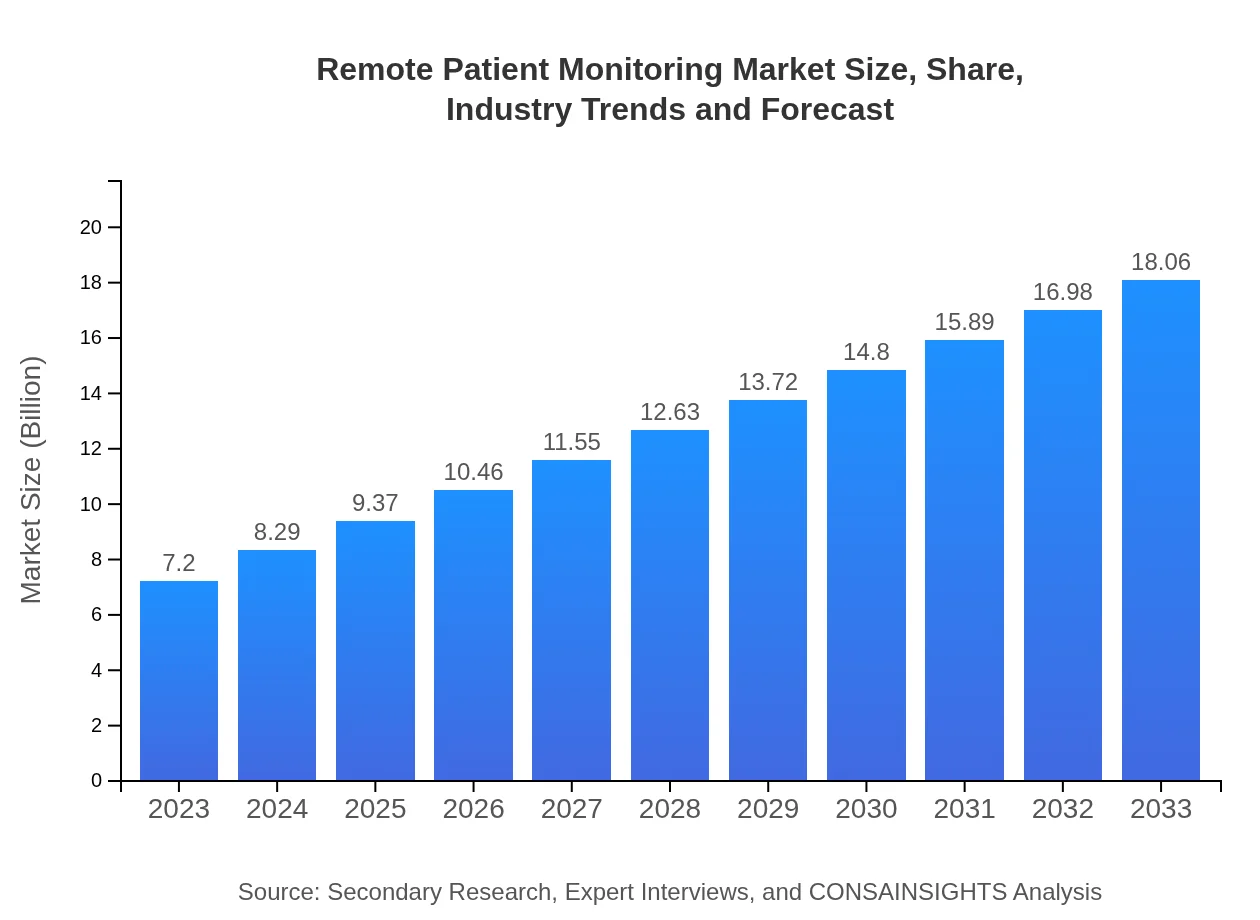
Remote Patient Monitoring Market Overview
Customize Remote Patient Monitoring Market Report market research report
- ✔ Get in-depth analysis of Remote Patient Monitoring market size, growth, and forecasts.
- ✔ Understand Remote Patient Monitoring's regional dynamics and industry-specific trends.
- ✔ Identify potential applications, end-user demand, and growth segments in Remote Patient Monitoring
What is the Market Size & CAGR of Remote Patient Monitoring Market Report market in 2023?
Remote Patient Monitoring Industry Analysis
Remote Patient Monitoring Market Segmentation and Scope
Tell us your focus area and get a customized research report.
Remote Patient Monitoring Market Report Market Analysis Report by Region
Europe Remote Patient Monitoring Market Report:
Europe grows from $1.87 Billion in 2023 to $4.68 Billion in 2033. Expansion reflects increasing integration of telehealth services, investments in digital health, and demand for chronic disease management enabled by wearable and communication technologies.Asia Pacific Remote Patient Monitoring Market Report:
Asia Pacific grows from $1.45 Billion in 2023 to $3.63 Billion in 2033. Market drivers include broader mobile connectivity, increasing chronic condition prevalence, and adoption of telehealth platforms and wearable monitoring solutions.North America Remote Patient Monitoring Market Report:
North America is largest regional market, rising from $2.39 Billion in 2023 to $5.99 Billion in 2033. The region's growth is underpinned by strong telehealth infrastructure, high uptake of connected devices, and supportive reimbursement policies that facilitate remote monitoring adoption.South America Remote Patient Monitoring Market Report:
Latin America grows from $0.6 Billion in 2023 to $1.51 Billion in 2033. Growth is influenced by expanding telemedicine initiatives, rising awareness of remote care benefits, and gradual uptake of monitoring devices and communication systems.Middle East & Africa Remote Patient Monitoring Market Report:
Middle East and Africa grows from $0.9 Billion in 2023 to $2.25 Billion in 2033. Drivers include investments in digital health infrastructure, policy support for telemedicine, and growing demand for remote management of chronic diseases.Tell us your focus area and get a customized research report.
Research Methodology
Remote Patient Monitoring Market Analysis By Device Type
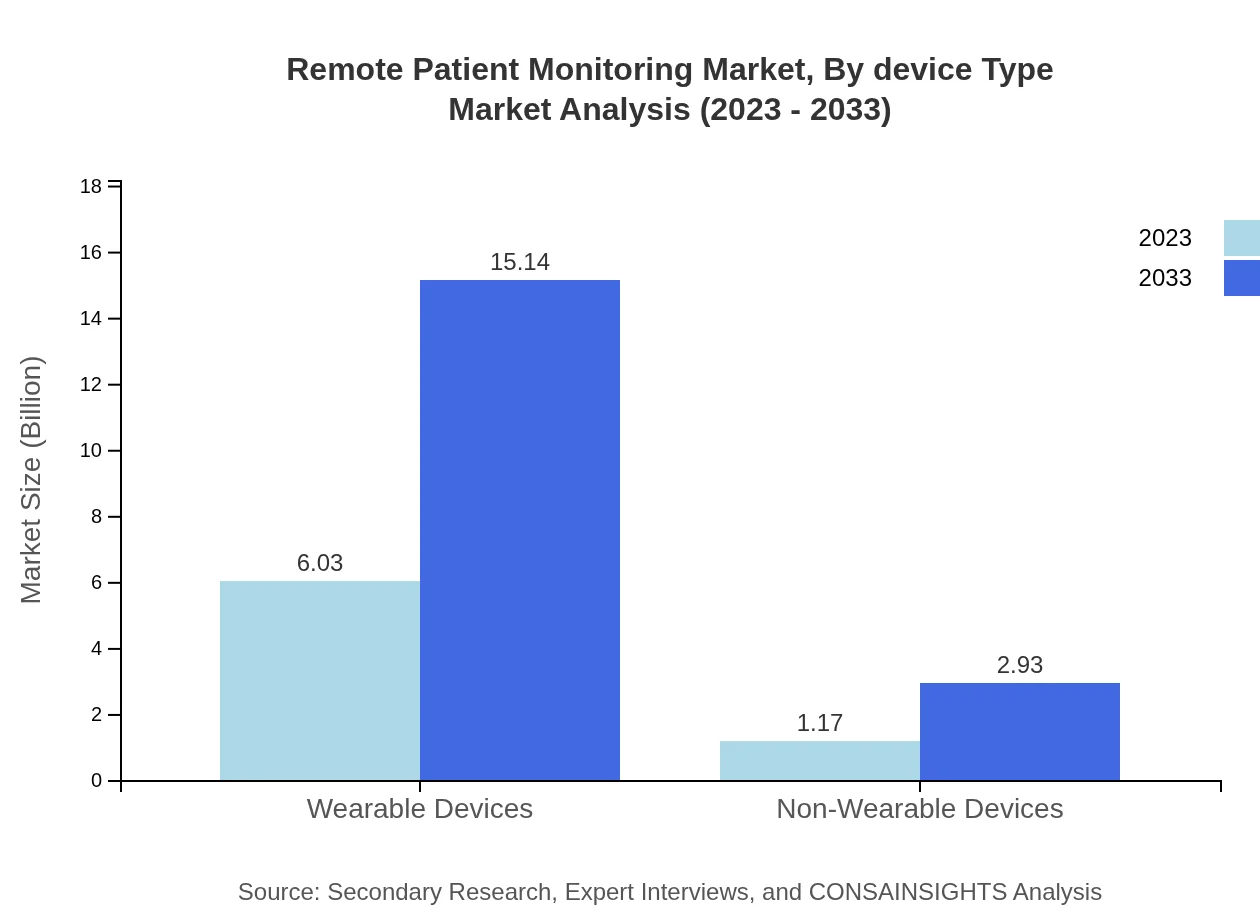
In 2023, the market for wearable devices is significant, generating $6.03 billion and expected to rise to $15.14 billion by 2033. Non-wearable devices currently contribute $1.17 billion and may grow to $2.93 billion by 2033. The category of wearable devices dominates market shares, accounting for 83.8% in both 2023 and 2033 due to ongoing advances in technology and user adoption.
Remote Patient Monitoring Market Analysis By Technology
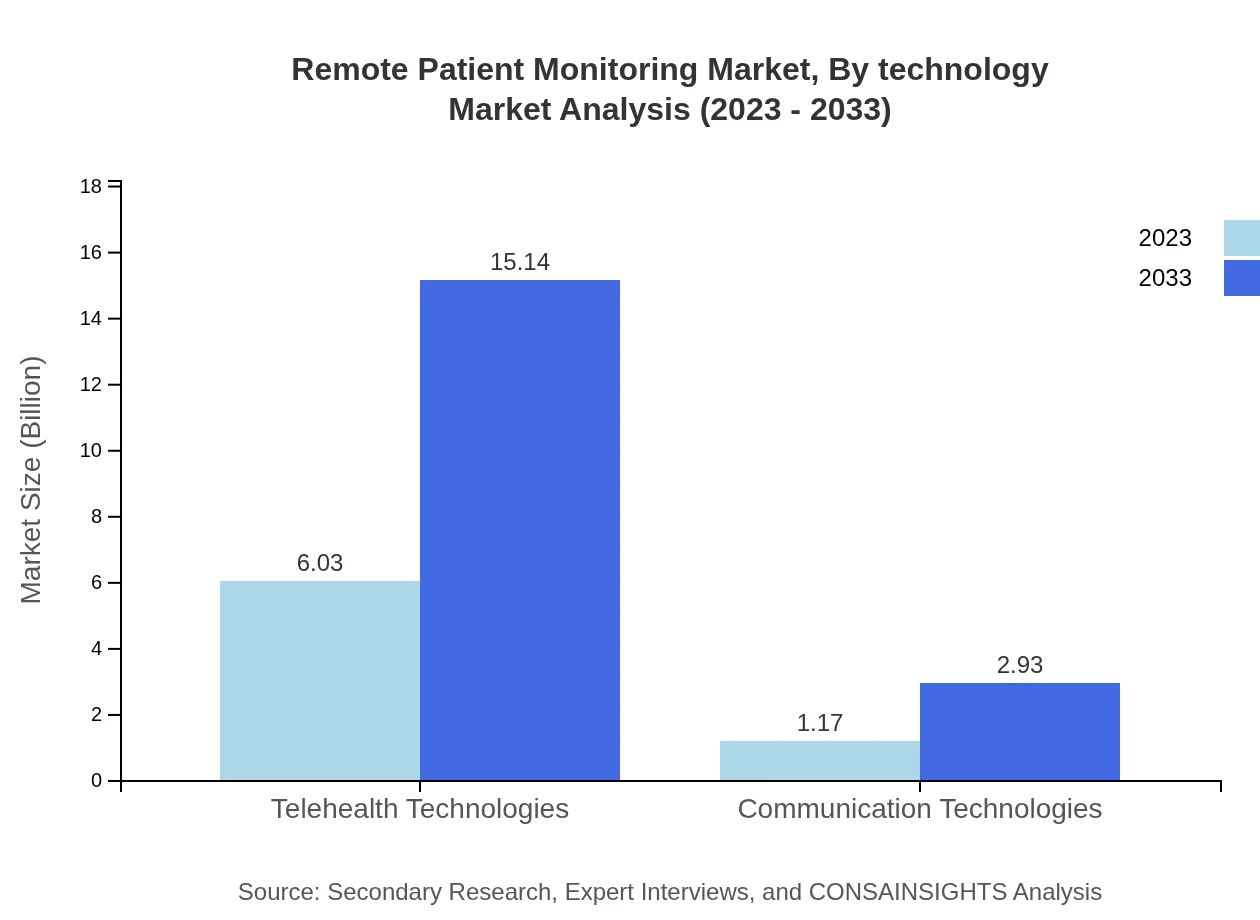
Telehealth technologies lead the RPM market, with a size of $6.03 billion in 2023 and anticipated growth to $15.14 billion by 2033. Communication technologies, although smaller, also show promise, increasing from $1.17 billion to $2.93 billion in the same timeframe. Telehealth constitutes 83.8% market share, reflecting its central role in RPM infrastructure.
Remote Patient Monitoring Market Analysis By Application Area
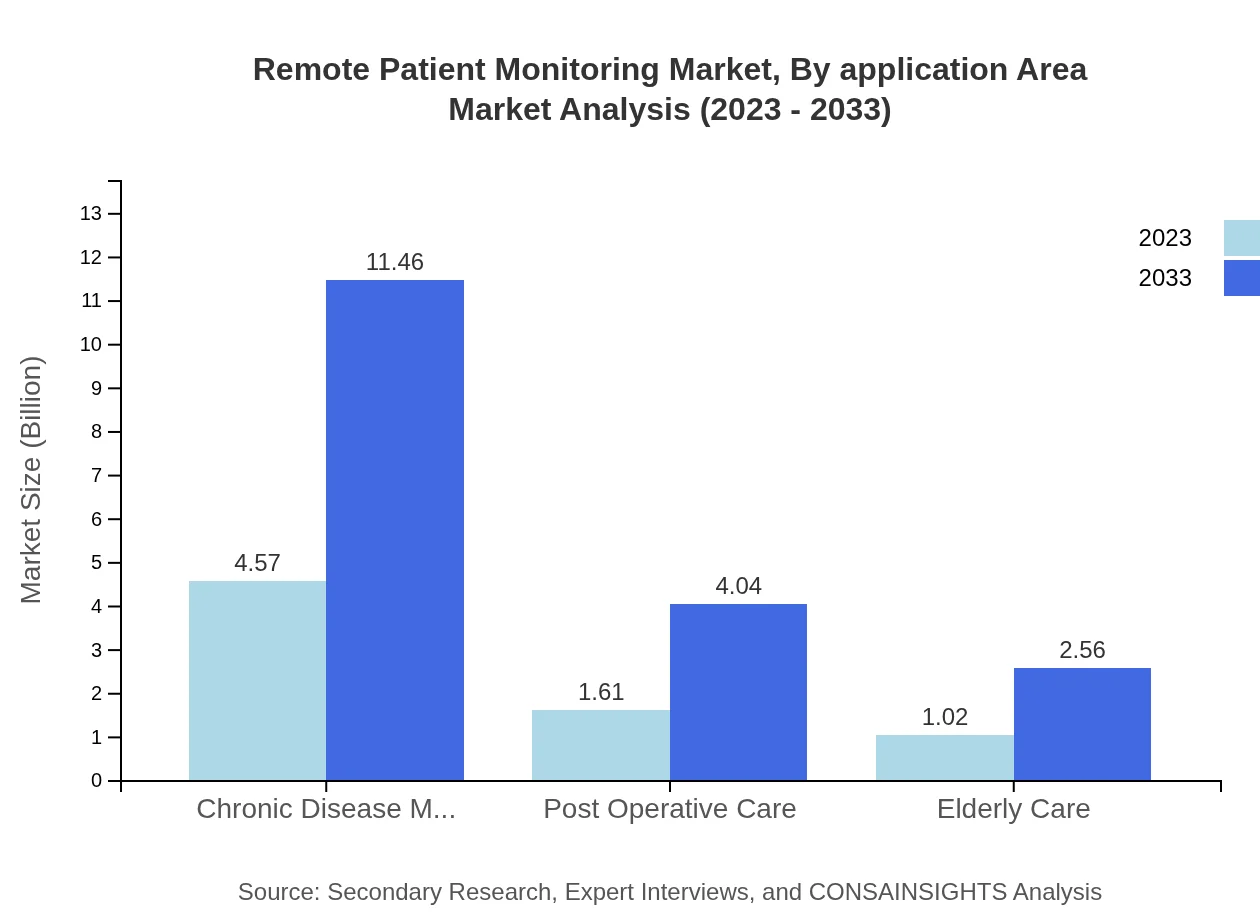
Chronic disease management is a key driver of RPM, with revenues transitioning from $4.57 billion in 2023 to $11.46 billion by 2033, maintaining a 63.47% market share. Post-operative care is growing rapidly, reaching $1.61 billion and moving past $4.04 billion in the forecast period, while elderly care also retains significant growth momentum.
Remote Patient Monitoring Market Analysis By End User
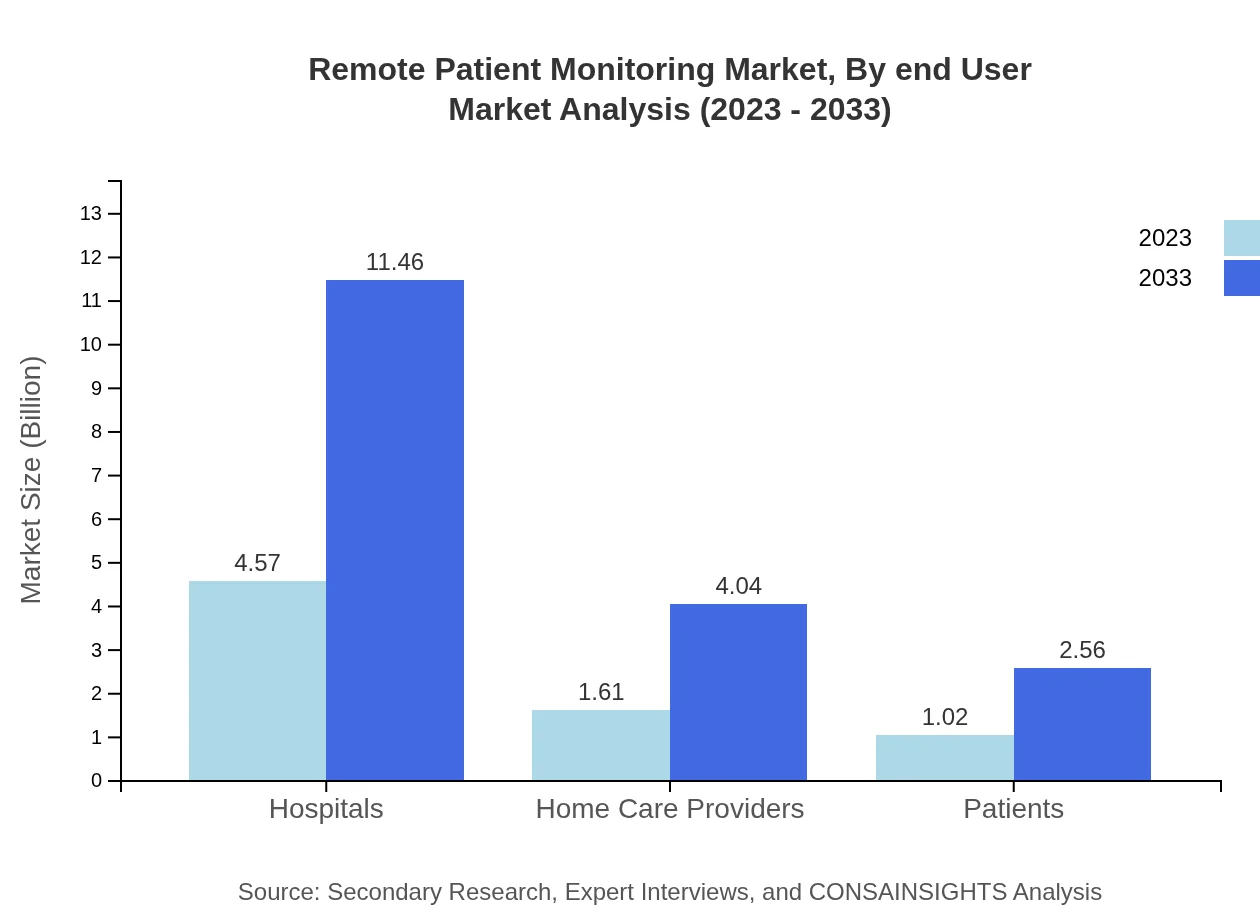
Hospitals generate a substantial portion of the RPM market, with a projected increase from $4.57 billion in 2023 to $11.46 billion by 2033, holding a steady 63.47% market share. Home care providers will also experience growth, expanding from $1.61 billion to $4.04 billion, reflecting the preferences of patients opting for care in their homes.
Remote Patient Monitoring Market Analysis By Region Application
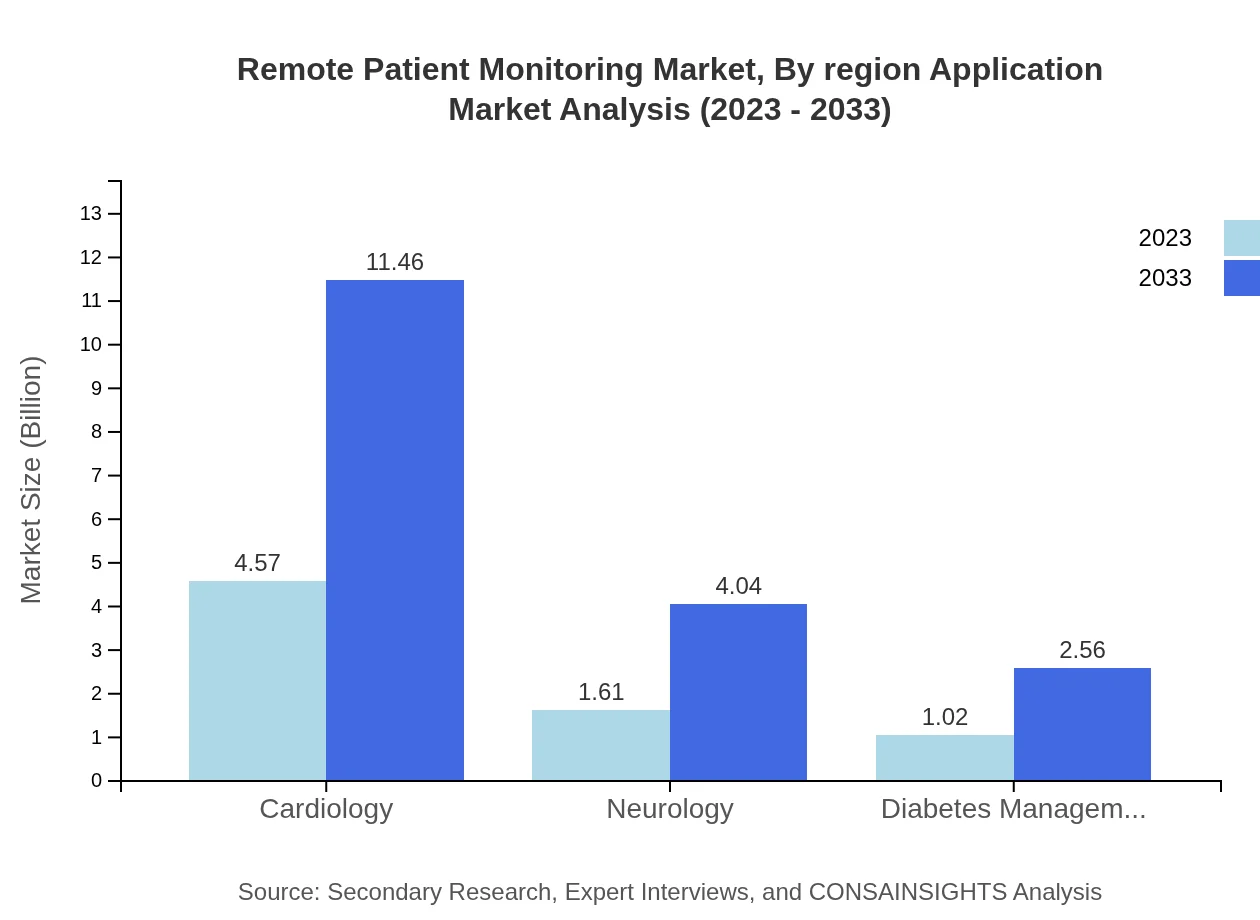
Regional analysis highlights North America's dominance, expanding its RPM market significantly influenced by innovative healthcare policies. Europe follows closely due to technological advancements, while emerging markets in Asia Pacific and Latin America show promising growth, driven by increasing healthcare demands and technological adoption.
Remote Patient Monitoring Market Trends and Future Forecast
Tell us your focus area and get a customized research report.
Global Market Leaders and Top Companies in Remote Patient Monitoring Industry
Philips Healthcare:
Philips Healthcare is a leading provider of health technology and has established a strong presence in RPM solutions through advanced remote monitoring systems that enhance chronic disease management and patient engagement.Medtronic :
Medtronic offers solutions focused on chronic condition management, providing extensive remote monitoring frameworks that improve patient outcomes and drive operational efficiency across healthcare providers.Cerner Corporation:
Cerner is a key player in health information technology, offering comprehensive RPM solutions that facilitate real-time data collection, telehealth services, and better care coordination.IBM Watson Health:
IBM Watson Health utilizes AI-driven insights in RPM, enhancing decision-making capabilities for healthcare providers while improving patient care delivery and monitoring efficiencies.Tunstall Healthcare:
Tunstall Healthcare specializes in telehealth and telecare solutions, focusing heavily on elderly care and chronic disease management, providing reliable RPM technologies across various healthcare settings.We're grateful to work with incredible clients.









FAQs
What is the market size of the Remote Patient Monitoring market in 2023?
The market size in 2023 is $7.20 Billion, as stated in the report's base year figure for global Remote Patient Monitoring.
How big is the projected market for 2033?
The market is projected to reach $18.06 Billion in 2033 according to the report's forecasted end-year value.
What is CAGR for the forecast period?
The report specifies a compound annual growth rate (CAGR) of 9.3% for the period 2023 to 2033.
Is there a single fastest Growing region in the Remote Patient Monitoring Market Report market?
No single fastest-growing region is stated for the Remote Patient Monitoring Market Report market because the top regional implied CAGR values are within 0.15 percentage points of each other, making the ranking too close to call reliably.
Why is remote patient monitoring gaining traction?
Adoption is driven by telehealth expansion, demand for chronic disease management, improved connected devices, and supportive policy and reimbursement trends.
Who are the leading companies in this market?
Top companies listed include Philips Healthcare, Medtronic, Cerner Corporation, IBM Watson Health, and Tunstall Healthcare.
What are common device types in the market?
Device categories include wearable devices and non-wearable devices, both specified as primary device-type subsegments.
How is the regional growth presented in the report?
Regional growth is provided with start and end values for 2023 and 2033 for North America, Europe, Asia Pacific, Latin America, and Middle East and Africa.
What is the forecast period covered by the report?
The forecast period covered in the report is 2023 to 2033, matching the stated base and end years.
What segmentation categories are included?
Segmentation covers end-user, technology, device type, application area, and regional application, with specific subsegments listed in the report.